Results tagged “nyc”
Eleven is What We Make
September 11, 2012
Yesterday, my son and I were coming back home to New York City, driving past the familiar skyline and its newest additions. Like a lot of toddlers, my boy's obsessed with all kinds of vehicles, so I wasn't surprised when he pointed at a flight that was descending towards LaGuardia and exclaimed "Plane!" His chance to see a jet moving over the skyline of lower Manhattan on a clear blue September day inspired nothing in him but sheer joy and excitement.
These are the gifts our children, or all children, give us every day in a million different ways. But they're also the gifts we give ourselves when we make something meaningful and beautiful. The new World Trade Center buildings are beautiful, in a way that the old ones never were, and in a way that'll make our fretting over their exorbitant cost seem short-sighted in the decades to come. More importantly, they exist. We made them, together. We raised them in the past eleven years just as surely as we've raised our children, with squabbles and mistakes and false starts and slow, inexorable progress toward something beautiful.
I didn't know that this day could be about looking forward and being hopeful instead of looking back with pain until something turned the corner last year. My city finally had something to show for what had been a void, an aching absence, for so long. And of course as is true with any remembrance, my perspective was as much a document of me as a memory of what had been; having become a parent reinforced my obligation to be optimistic and open-hearted about the future.
So today I keep just the essential parts of what I learned on September 11th eleven years ago. That life is brief and valuable. That we can be our best selves when we help each other. That people are fundamentally kind, brave and empathetic. That there's a place for us all, and mine is New York City. And that there is no burden or grief or pain or challenge so great that it can keep us from still trying to make something meaningful.
Looking Back
Each year, I have observed the 9/11 anniversary after having documented my experience in NYC on the day of the attacks. I do so largely as a record of my own changing perspectives on that time and that place, since so many others do a much better job at discussing the larger political and social and cultural aspects of the day and all that's happened since. A brief look back:
Last year for the 10th anniversary, Ten is Love and Everything After:
I don't have any profound insights or political commentary to offer that others haven't already articulated first and better. All that I have is my experience of knowing what it mean to be in New York City then. And from that experience, the biggest lesson I have taken is that I have the obligation to be a kinder man, a more thoughtful man, and someone who lives with as much passion and sincerity as possible. Those are the lessons that I'll tell my son some day in the distant future, and they're the ones I want to remember now.
In 2010, Nine is New New York:
[T]his is, in many ways, a golden era in the entire history of New York City.
Over the four hundred years it's taken for this city to evolve into its current form, there's never been a better time to walk down the street. Crime is low, without us having sacrificed our personality or passion to get there. We've invested in making our sidewalks more walkable, our streets more accommodating of the bikes and buses and taxis that convey us around our town. There's never been a more vibrant scene in the arts, music or fashion here. And in less than half a decade, the public park where I got married went from a place where I often felt uncomfortable at noontime to one that I wanted to bring together my closest friends and family on the best day of my life. We still struggle with radical inequality, but more people interact with people from broadly different social classes and cultures every day in New York than any other place in America, and possibly than in any other city in the world.
And all of this happened, by choice, in the years since the attacks.
In 2009, Eight Is Starting Over:
[T]his year, I am much more at peace. It may be that, finally, we've been called on by our leadership to mark this day by being of service to our communities, our country, and our fellow humans. I've been trying of late to do exactly that. And I've had a bit of a realization about how my own life was changed by that day.
Speaking to my mother last week, I offhandedly mentioned how almost all of my friends and acquaintances, my entire career and my accomplishments, my ambitions and hopes have all been born since September 11, 2001. If you'll pardon the geeky reference, it's as if my life was rebooted that day and in the short period afterwards. While I have a handful of lifelong friends with whom I've stayed in touch, most of the people I'm closest to are those who were with me on the day of the attacks or shortly thereafter, and the goals I have for myself are those which I formed in the next days and weeks. i don't think it's coincidence that I was introduced to my wife while the wreckage at the site of the towers was still smoldering, or that I resolved to have my life's work amount to something meaningful while my beloved city was still papered with signs mourning the missing.
In 2008, Seven Is Angry:
Finally getting angry myself, I realize that nobody has more right to claim authority over the legacy of the attacks than the people of New York. And yet, I don't see survivors of the attacks downtown claiming the exclusive right to represent the noble ambition of Never Forgetting. I'm not saying that people never mention the attacks here in New York, but there's a genuine awareness that, if you use the attacks as justification for your position, the person you're addressing may well have lost more than you that day. As I write this, I know that parked out front is the car of a woman who works in my neighborhood. Her car has a simple but striking memorial on it, listing her mother's name, date of birth, and the date 9/11/2001.
In 2007, Six Is Letting Go:
On the afternoon of September 11th, 2001, and especially on September 12th, I wasn't only sad. I was also hopeful. I wanted to believe that we wouldn't just Never Forget that we would also Always Remember. People were already insisting that we'd put aside our differences and come together, and maybe the part that I'm most bittersweet and wistful about was that I really believed it. I'd turned 26 years old just a few days before the attacks, and I realize in retrospect that maybe that moment, as I eased from my mid-twenties to my late twenties, was the last time I'd be unabashedly optimistic about something, even amidst all the sorrow.
In 2006, After Five Years, Failure:
[O]ne of the strongest feelings I came away with on the day of the attacks was a feeling of some kind of hope. Being in New York that day really showed me the best that people can be. As much as it's become cliché now, there's simply no other way to describe a display that profound. It was truly a case of people showing their very best nature.
We seem to have let the hope of that day go, though.
In 2005, Four Years:
I saw people who hated New York City, or at least didn't care very much about it, trying to act as if they were extremely invested in recovering from the attacks, or opining about the causes or effects of the attacks. And to me, my memory of the attacks and, especially, the days afterward had nothing to do with the geopolitics of the situation. They were about a real human tragedy, and about the people who were there and affected, and about everything but placing blame and pointing fingers. It felt thoughtless for everyone to offer their response in a framework that didn't honor the people who were actually going through the event.
In 2004, Thinking Of You:
I don't know if it's distance, or just the passing of time, but I notice how muted the sorrow is. There's a passivity, a lack of passion to the observances. I knew it would come, in the same way that a friend told me quite presciently that day back in 2001 that "this is all going to be political debates someday" and, well, someday's already here.
In 2003, Two Years:
I spent a lot of time, too much time, resenting people who were visiting our city, and especially the site of the attacks, these past two years. I've been so protective, I didn't want them to come and get their picture taken like it was Cinderella's Castle or something. I'm trying really hard not to be so angry about that these days. I found that being angry kept me from doing the productive and important things that really mattered, and kept me from living a life that I know I'm lucky to have.
In 2002, I wrote On Being An American:
[I]n those first weeks, I thought a lot about what it is to be American. That a lot of people outside of New York City might not even recognize their own country if they came to visit. The America that was attacked a year ago was an America where people are as likely to have been born outside the borders of the U.S. as not. Where most of the residents speak another language in addition to English. Where the soundtrack is, yes, jazz and blues and rock and roll, but also hip hop and salsa and merengue. New York has always been where the first fine threads of new cultures work their way into the fabric of America, and the city the bore the brunt of those attacks last September reflected that ideal to its fullest.
In 2001, Thank You:
I am physically fine, as are all my family members and immediate friends. I've been watching the footage all morning, I can't believe I watched the World Trade Center collapse...
I've been sitting here this whole morning, choking back tears... this is just too much, too big. I can see the smoke and ash from the street here. I have friends of friends who work there, I was just there myself the day before yesterday. I can't process this all. I don't want to.
Captive Atria and Living In Public
March 5, 2012
The idea of "public space" used to be pretty simple; There were places that we all agreed would be maintained by, and for, the public good. But the past few decades have offered up a valuable, if troubling, experiment with the nature of public space in New York City. For any of us who care about community, whether that's in our cities or on the web, there are some profound lessons to learn.

In 1961, New York City adopted a new zoning program that allowed commercial buildings to exceed the constraints which zoning regulations required of them if they made accommodations for use as Privately-Owned Public Spaces. Fifty years later, the legacy of that decision is documented well on the Department of City Planning website. (On a page which has this wonderful short URL: nyc.gov/pops!)
So, how did this experiment fare? Well, in the words of the city itself:
The results of the program have been mixed. An impressive amount of public space has been created in parts of the city with little access to public parks, but much of it is not of high quality. Some spaces have proved to be valuable public resources, but others are inaccessible or devoid of the kinds of amenities that attract public use. Approximately 16 percent of the spaces are actively used as regional destinations or neighborhood gathering spaces, 21 percent are usable as brief resting places, 18 percent are circulation-related, four percent are being renovated or constructed, and 41 percent are of marginal utility.
In response to the perceived failure of many of these spaces and to community opposition, the types of spaces permitted and their locations have been curtailed in recent years.
Just to highlight that again: only 16% of privately-owned public spaces can be considered successful. By the city's own reckoning, a full 41% are of marginal utility. How complete is the failure? According to all of the research I've been able to do, not a single POPS was used for any of the various #Occupy demonstrations except for Zuccotti Park, though one nearby plaza was used for Occupy planning meetings. (Note: I'd love to be corrected on this.) Imagine: there are ostensibly "public" spaces within the buildings that some of the major financial institutions actually work in, and yet they're so terrible and unusable that even protestors didn't make use of them.
The Beating Heart of the Atrium
Most POPS in Midtown Manhattan take the form of the atrium in an enormous office tower, where the owners post a sign declaring which hours the space is available to the public, and then decorate it with the POPS logo seen above. But there would be precious few New Yorkers who, even if they did recognize that symbol, could tell you what it means.
These public spaces, then are Captive Atria. They're ostensibly "public" spaces which, by nature of being owned by a corporation, are held captive to that company and thus fail in their intended use as public space. Put another way: Government is infinitely more effective and efficient in creating valuable, useful public space than private companies are. The evidence is all over New York City, in the grim, wind-blown pedestrian plazas and captive atria ghost towns which all of us hurry through with hunched shoulders on cold winter days.
What About The Web?
Tellingly, we seldom have discussions about web community in the language of urbanism or urban planning. But what we've seen documented through more than fifty years of experimentation in New York City is that we cannot effectively create public spaces in places that are owned by a company. Yet, we're increasingly ceding our public discourse to platforms and services which exactly mimic the traits of our sterile captive atria in the physical world.
While many in the Occupy movement bemoaned the fact that the private owners of Zuccotti Park had extensive control over what people could do in their space, that control is nothing compared to the typical Terms of Service of a social networking site. Whether it's Facebook, Twitter, Google+ or anything else, no meaningful act of protest would have to be tolerated at all by owners.
But let's put aside protest. What about all the simpler, everyday uses of public space? In captive atria, there are generally no food trucks offering distinctive meals, no performing artists even of the caliber of the musicians that play in the NYC subway, and there's generally such sparse usage that you don't even get the wonderful serendipitous meetings with friends and acquaintances that you get in a true public space.
What we don't realize is that our online public spaces are increasingly being given over to private owners whose spaces share the same weaknesses. It's difficult, if not impossible, to connect to or share with people with whom you haven't declared an explicit relationship. People who you don't follow or befriend or encircle may as well not exist.
More to the point, transgressions of the space, whether political or artistic, are prohibited in practice, even if they aren't always done so in writing. Imagine Improv Everywhere trying to perform its acts of rule-breaking brilliance in the confines of a space that was owned and controlled by a company. Now imagine you wanted to do the same thing online, carrying out an artistic performance which required you to impersonate another person's identity or to falsely claim affiliation with an organization that you don't belong to. In most cases, it simply can't be done.
I care about political protest, sure. But even more often, I care about being inspired by art, and being entertained by comedians and trolls and impersonators and other amusing rule-breakers. I'm happy that New York City has learned enough of a lesson that it's stopped giving license to companies to create POPS, and properly invested in true public spaces. Now I hope we'll take the same lesson to the web, and challenge the big networks to actually change their policies to make some of our shared online spaces truly public. That way, we get heart-warming public creations like this one:
Foursquare: Today's best-executing startup
January 3, 2012
About two years ago, Fred Wilson and I were talking about which startups we found interesting and I mentioned offhandedly that Foursquare was far and away the one that I thought had the most potential to be a huge, meaningful business. I'm sure Fred (and Union Square Ventures) had many other people recommend Foursquare to them both before and after that day, and of course their subsequent investment proved that Foursquare was compelling to the USV team. But at that point, it was still early enough in Foursquare's evolution that Fred was surprised both at the vehemence of my optimism for the young company (which at the time still consisted of just Dennis and Naveen) as well as how casually I just assumed they'd be a huge success. At the time, I hadn't really critically considered why I was so bullish on the company, I just knew at a gut level that it had a ton of potential.

Two years later, what seemed like unformed potential has blossomed into truly impressive execution: Foursquare is the one startup that's doing the most remarkable job of any company out there in product strategy and product creation. Though they've obviously gotten a lot of attention for their success, I think some of the nuances of what they're pulling off have remained non-obvious, and wanted to document what's interesting far beyond the amount of dollars of venture capital funding they've amassed.
Of note: I don't have any stake in Foursquare except in some broad sense that I want NYC startups to succeed, I like that the company is independent of big companies like Facebook, and I'm friends with a number of folks at the company (including the founders) and would be pleased to see them do well. Also, I'm going to describe some of the things that they're doing from my perspective as an educated outsider to the company — I haven't talked to anyone at Foursquare about this post, so it may not reflect every detail of what they've pulled off, but hopefully the spirit is correct and Foursquare folks can respond in the comments or on their blogs to correct any inaccuracies.
What's the big deal?
- Core Platform: The first, and perhaps most fundamental, brilliance in Foursquare's product execution is the recognition of the ubiquity of geolocation features in mobile platforms and the identification of declarations of place as a form of establishing identity online. While much has been made about the gamification aspect of Foursquare's design, I actually don't think that's the biggest innovation responsible for the platform's success; Identifying when small incremental improvements to hardware have enabled a profound and fundamental improvement to software capabilities is the sort of thing that's usually the exclusive province of companies like Apple and Microsoft, and yet Foursquare's pulled that off out of the gate.
- Reliable Iteration: Foursquare's removed features from the core app a few times, constantly changes the design of its flagship iOS application, and in general asserts its authority over the experience that users have within the Foursquare application. Yet, unlike every single other major social application, they don't inspire mass user revolts or negative press every time they iterate. Some of this is that they practice WWIC 101, vetting ideas with actual users as they begin to test them, including the very key fact that the company's founders are very public, visible, and enthusiastic users of the service itself, ensuring not just an attention to detail but a deep fluency in the application's limits and shortcomings as well. But part of this is the small, well-paced timing of iteration on the application where there are always small things changing in ways that aren't wildly disruptive, but do enough to set a tone that users know to expect the furniture might get rearranged once in a while. This type of iteration is extremely difficult to balance well, and it underpins the other successes outlined here.
- Technical Competence: Foursquare's slow sometimes, and I never know if failures in the app are due to something on Foursquare's part or due to the vagaries of an AT&T connection in Manhattan. This is a great thing. Pushing areas of uncertainty to known points of failure where users already expect some frustration takes away a lot of the antagonism that people would otherwise feel towards Foursquare if its technical errors were clearly just Foursquare's fault. Just as importantly, new features are introduced across all platforms simultaneously, and they consistently work at scale even as Foursquare's user base rapidly increases in number. These kinds of successes are extremely difficult to pull off at scale, and are usually only visible when they fail. In this category, no news is good news, and unlike Twitter or Flickr or Tumblr or other services which preceded Foursquare as the "hot" social startup of the moment, Foursquare doesn't even have a signature "failure" message like the Fail Whale or "Is Having A Massage".
Design Innovation: Mari Sheibley's signature design style has defined Foursquare's public face since its earliest days, and the entire design team at Foursquare has maintained a design aesthetic that's distinctive and playful without being cloying, in support of an interaction model that's surprisingly clear given the depth of features that the platform supports. For example, I don't really pay any attention to the points-and-leaderboard part of the service, and despite the richness of functionality available around those features, I never have to see them since they're tucked away under one tab in the iOS app. Similarly, while Lists invite an interesting form of discovery, I'm only gradually engaging with the feature, and the architecture of the app supports dipping into this area without resorting to the "here's a blinking light you need to dismiss" prompts of analogous features like the "Discover" tab in the new Twitter client for iOS. More fundamentally, an incredibly rich information model is represented consistently and elegantly across the app on all its platforms, even though displaying just a simple list of what my friends are up to incorporates elements including avatars, nicknames, mayoralty indicators, place names, location data, time/date information, live maps, comment boxes, and icons indicating venue types. Keeping information this dense while also having it be comprehensible and flexible enough to accommodate constant feature iteration is a formidable challenge, made all the more impressive by having a design language that's consistent across different resolutions and platforms, and still distinct enough to be recognizable when it's applied more broadly. Put another way: Foursquare's design is fun enough that I'd fully expect to see hipsters wearing Foursquare-themed ironic tees by springtime, and very few brands that are only two years old have enough visual identity to be worth parodying that quickly.- Thoughtful Business Model: The single biggest prompt for me to write this post was the sheer jaw-dropping impressiveness of the Small Business Saturday promotion that Foursquare pulled off in conjunction with American Express on the Saturday after Thanksgiving. While it's obvious that any company that you voluntarily give information about your location and shopping habits to should be able to build a meaningful business out of that data, there are still a million ways that incorporating those business opportunities into an app could be screwed up in a way that'd be permanently off-putting to users. But Foursquare didn't just avoid those traps -- this very young company delivered a unique new ecommerce integration built into their platform that 1. Shipped on time for the Thanksgiving holiday weekend 2. Functioned properly across all platforms for millions of users 3. Didn't wildly disrupt the existing uses of the app 4. Provided meaningful financial incentives (a $10 credit) to actually use the new features 5. Provided a meaningful social justification for the new features by encouraging support for local businesses 6. Was easy enough to use that signing up basically involved quick one-time entry of a credit card number and 7. Seamlessly interacted with a partner's complex financial systems (who knows what kind of APIs American Express provides to partners?) in a way that was so seamless as to be invisible. While a few users tweeted about liking the promo, from the standpoint of a startup executing on an ambitious product vision, this was an absolute tour de force, and one of the most impressive product launches I've ever seen a small company pull off.
- Meaningful APIs: One of the great things about Foursquare's APIs is that they don't just give other companies the opportunity to plug in to Foursquare's data, they support the creation of experiences that are actually meaningful. Just one example is articulated well in this piece on digital nostalgia, showing how the wonderful Timehop has built a thoughtful and evocative experience on top of the Foursquare API, simply by reminding us of where we've been in the past. I expect people will be making apps that are as valuable as they are meaningful in short order, as well.
What's it mean?
While there may be individual companies that have out-executed Foursquare in these individual areas, the combination of the team's relatively small size, the growth rate in the user base, and the consistency of execution across all of these areas while also growing the company as a whole is incredibly impressive. Particularly important to me is that everyone from Dennis and Naveen on down within the company speaks about the vision that they have for what Foursquare can become, as opposed to short-term thinking or resting on the (not inconsiderable) hype that's been lavished on the company.
I point out this success for selfish reasons, too — I'd love to see more companies that both remain independent of the big players in the tech industry while staying focused on creating meaningful, large-scale products that aren't just simple features. The breadth of successes that Foursquare's had recently also point out to the fundamental wisdom they had in choosing not to be part of a bigger company like Facebook, as Facebook's own failures in this area stand in stark contrast, despite their advantages in scale, money, developers and resources.
But perhaps most importantly, I think we need more stories that celebrate the success of what seem like small, iterative product launches, but actually reflect triumphs in unsung disciplines such as systems operations, design process, business development and product management. There are lots of loud, pointless headlines about companies getting money from venture capitalists or angel investors. What I'd love to see more of in 2012 (and beyond!) is headlines about how a few small successes with users are a demonstration of a small company outperforming and out-innovating the biggest companies in the tech industry by being focused and disciplined in their execution. That, actually, is my most favorite Foursquare feature.
Readability And Intention
November 17, 2011
The latest launch I'm ecstatic to share with you all: My friends at Readability (whom I advise) announced their amazing new platform! Though it's best known as a simple way to clean up the formatting of an article that you're reading on the web, there's an incredible depth to what Readability now offers:
- A terrific service that integrates with any web browser to make reading more pleasant either now or whenever you have time to read — and now that service is free!
- A brand new HTML5 web app that lets you read on the go on any platform, soon be joined by a beautiful iOS app that will let you read on your iPhone or iPad
- A robust and inspiring API that powers the entire Readability platform, which is already starting to upgrade some already-amazing apps like Reeder and TweetMag
But as cool as all that news is, I'm even more excited about what's in store in the future for Readability, and I thought I'd explain why.
Things Can Be Beautiful
Just one small, wonderful detail about the upcoming Readability apps for iOS epitomizes why I can't wait for Apple to approve them: Every time you're reading in the new apps, you're seeing typography by Hoefler & Frere-Jones. I'm certainly no designer, but even from a layman's perspective, I know what a big deal it is to be the first app to have this level of type expertise be applied to the reading experience.
It's not just the font-hipster value of reading a headline set in Gotham or body copy in Whitney; What I'm struck by is the sheer commitment to quality in an app experience down to the finest level of detail. The Readability team teamed up with Teehan + Lax to make what I'm comfortable calling the best-designed, most attractive mobile apps I've ever seen. In a world where every Apple blogger is wringing their hands over skeuomorphism, it's delightful to see a family of apps go the other way into pure, beautiful function.
A Real Platform
The geek in me cares about what's under the hood, though, too. And as no less an authority than Dave Winer noted, Readability's new API is formidable. I frankly didn't get it a few years ago when Dave was always so excited about OPML and reading lists, but these days I understand that a simple, synchronized list of the content that matters to you is something that should almost exist at the operating system level. It should just be baked into everything you do.
The experience of an "it just works" synching system in the cloud is powerful. For files, I get that experience from Dropbox. For notes, I wanted that experience from Evernote, but always got too much other crap. (Note: Evernote's a very nice app, and I know lots of people love it, but I just want things to be clean and simple and not full of all kinds of bells and whistles for tasks as important as reading.) Managing that type of synchronization across all my phones and tablets and laptops and desktops and other systems is a significant task, and it's impressive that Readability is poised to do that for me not just in all the Readability apps, but even across my other apps as well.
That's not to say that the basic "let's clean up this page" capability of apps like Evernote isn't valuable — it's great! But that much is built in to the browser on my phone these days. What I care about is having the information that I want to read be available wherever I am, in the format that's most readable. It's a capability that I firmly believe will be baked in to all of my most commonly-used tools and apps in the years to come. And it's a vision that's much bigger than any one app.
Trust and Values
Of course, as I noted yesterday, I also care a lot about owning and controlling my data. Readability's API makes it very easy for me to manage and maintain a list of what I'm reading without giving up my ownership of that list. I can take my ball and go home, but just as importantly, I can take my list and plug it in to whatever else I'm doing.
That's critical because, as I'd noted at the beginning of this year when I first joined Readability as an advisor, reading is a profound and meaningful experience, and in my opinion is among the most valuable things we can do with our time on the Internet. I need it to be everywhere that I am, and I need to trust that the platform which powers my reading online shares those values. Even for simple things, like not sharing my reading behavior without my express permission.
The best way I can show the character of the team behind Readability and the community around it is by talking about who's not working with Readability's platform — yet. Marco Arment, creator of Instapaper and a former fellow Readability advisor, had a thoughtful and respectful note about the fact that he and the Readability team have gone their separate ways now that their respective apps are slightly more competitive with one another.
I don't mean to tell tales out of school, but I know the Readability team respects Marco as much as he respects them, and the fact that innovative, creative entrepreneurs can work together (or work apart) in such productive ways is why I'd feel safe as a developer building on Readability's platform. And I hope to see Instapaper and the Readability platform (both of which I happily pay for) work together at some point in the future.
But, for that matter, I hope to see Readability baked into Google Chrome and Microsoft Word and iBooks and all the other apps I use every day, too.
Read Later
There's a lot more I can say about Readability because I'm so excited by the platform's potential. But for now, there are a few key points I'd start with if you want to explore more:
- Readability's API is going to be one of the most meaningful tools that developers can bake into their apps in the months to come. It really does remind me of the early days of Twitter's API, in the feeling that it inspires in me to want to spend a weekend hacking on it.
- Readability is also one of the key APIs that support this year's NYC BigApps challenge, where you can win your share of $50,000 in prizes as a developer. I think this year's apps are guaranteed to be the best ever in a BigApps contest.
- You may want to revisit Reading is Fundamental, where I mentioned earlier this year the ideas that made me so passionate about Readability and its potential.
- CNN has an odd, but sort of charming, look at the new Readability. I preferred Ben Popper's take at Betabeat.
- And, going back more than four years, To Read is To Be Human, when I first started reflecting on the optimism and idealism that's captured in the simple action that so many of us do every day when we save an article with the intention of reading it in the future.
Ten is Love and Everything After
September 11, 2011
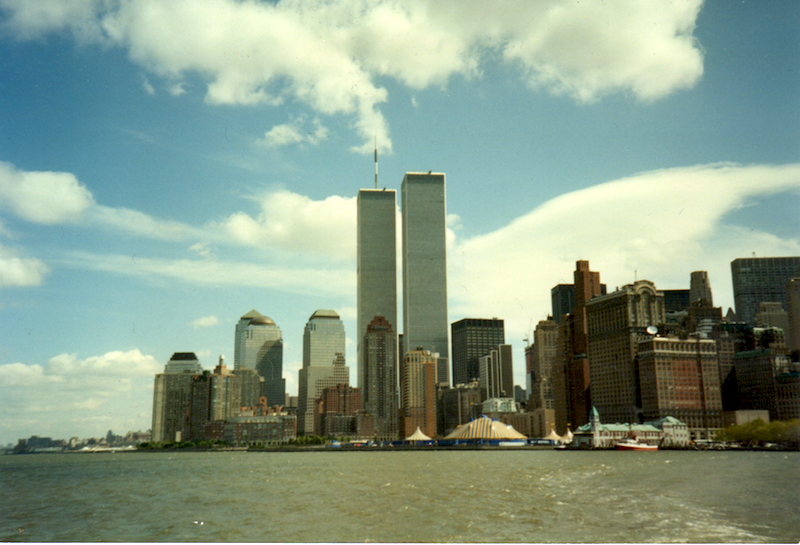
I took this photo on a cool spring day twenty years ago, on the day I fell in love for the first time that would last.

I'd been to New York City a number of times before then, but at fifteen years old I took this photo on my first trip to the city without my parents. Surrounded by my high school friends, we saw a Broadway show, took the ferry to Liberty Island (whence this photo), and went to the top of the World Trade Center for my very first time. I didn't even really know the geography of New York harbor back then, so I had little appreciation of what I was looking at, but the view stayed vivid enough in my mind that I remembered it instantly the next, and final, time that I went to the top of the World Trade Center in August of 2001.
I can't honestly say that it was because of that trip to one particular skyscraper, but the entirety of that visit to New York City had kicked off a lifelong love affair; I knew by the end of that day that, at least for a little while, I'd end up living in New York City. There was a lesson that day about finding your place, and pursuing a dream, even in a world of impermanence.
What I would never have imagined back in high school, or especially in the days after the attacks here ten years ago, was that I'd not just choose to live here, but that I'd stay here. That I'd get married in New York City. That I'd raise a family here. And perhaps more importantly, that I'd eventually learn enough from the pain and sorrow of that day to grow in to a man who may even be worthy of the opportunity to do so.
Always Remember
Sure, we all promised in the days after the attacks that we'd be more thoughtful, more understanding, more patient. I did a pretty lousy job of it at first; Even a year later I was getting in stupid political arguments on the Internet. But gradually, I have learned to be more empathetic towards people I disagree with, and I have fought (not always successfully) to be respectful towards people who have different beliefs than me. More important than the political beliefs, though, are the cultural ones — I finally let go of so much of the bitterness and resentment I'd had over being made to feel inferior simply for being different than most people in American culture.
Some of this might have been due to the simple fact that I grew up. The attacks happened a few days after I turned 26 years old, and I was so alone that my wish for someone to hold on to is one of the most consistent refrains from my blog posts at the time. By contrast today, I'm a happily married man who will celebrate his sixth anniversary in a few weeks with our little boy by our side. I had the chance to leave New York City and then return. I've lived a lot in this decade, and been fortunate to do so.
Even with all of those changes, though, I do know that the fundamental turning point for choosing to live a more meaningful, thoughtful and empathetic life was being here in New York City on September 11, 2001. That's not to diminish the loss and pain that so many others suffered — my sister was living in Washington, DC on that day, and my mother was in my childhood home in central Pennsylvania. And I by no means dismiss the profound, and painful mistakes that our country and culture have made in many of our responses to that day. I will say that, despite the conventional refrain that "everything changed" on that day, I find it's less true that the big profound things have changed than that a million small things were transformed.
After a decade of people insistently using that day and the attacks as a cultural milestone, I don't have any profound insights or political commentary to offer that others haven't already articulated first and better. All that I have is my experience of knowing what it mean to be in New York City then. And from that experience, the biggest lesson I have taken is that I have the obligation to be a kinder man, a more thoughtful man, and someone who lives with as much passion and sincerity as possible. Those are the lessons that I'll tell my son some day in the distant future, and they're the ones I want to remember now.
Each year, I've taken time to look back and remember, ever since the day of the attacks in 2001. I'm not sure there's a pattern or progression to the various pieces that I've written, but I do see that there's been an evolution, and I hope it's one that does justice to the memory of that day.
Last year in 2010, Nine is New New York:
[T]his is, in many ways, a golden era in the entire history of New York City.
Over the four hundred years it's taken for this city to evolve into its current form, there's never been a better time to walk down the street. Crime is low, without us having sacrificed our personality or passion to get there. We've invested in making our sidewalks more walkable, our streets more accommodating of the bikes and buses and taxis that convey us around our town. There's never been a more vibrant scene in the arts, music or fashion here. And in less than half a decade, the public park where I got married went from a place where I often felt uncomfortable at noontime to one that I wanted to bring together my closest friends and family on the best day of my life. We still struggle with radical inequality, but more people interact with people from broadly different social classes and cultures every day in New York than any other place in America, and possibly than in any other city in the world.
And all of this happened, by choice, in the years since the attacks.
In 2009, Eight Is Starting Over:
[T]his year, I am much more at peace. It may be that, finally, we've been called on by our leadership to mark this day by being of service to our communities, our country, and our fellow humans. I've been trying of late to do exactly that. And I've had a bit of a realization about how my own life was changed by that day.
Speaking to my mother last week, I offhandedly mentioned how almost all of my friends and acquaintances, my entire career and my accomplishments, my ambitions and hopes have all been born since September 11, 2001. If you'll pardon the geeky reference, it's as if my life was rebooted that day and in the short period afterwards. While I have a handful of lifelong friends with whom I've stayed in touch, most of the people I'm closest to are those who were with me on the day of the attacks or shortly thereafter, and the goals I have for myself are those which I formed in the next days and weeks. i don't think it's coincidence that I was introduced to my wife while the wreckage at the site of the towers was still smoldering, or that I resolved to have my life's work amount to something meaningful while my beloved city was still papered with signs mourning the missing.
In 2008, Seven Is Angry:
Finally getting angry myself, I realize that nobody has more right to claim authority over the legacy of the attacks than the people of New York. And yet, I don't see survivors of the attacks downtown claiming the exclusive right to represent the noble ambition of Never Forgetting. I'm not saying that people never mention the attacks here in New York, but there's a genuine awareness that, if you use the attacks as justification for your position, the person you're addressing may well have lost more than you that day. As I write this, I know that parked out front is the car of a woman who works in my neighborhood. Her car has a simple but striking memorial on it, listing her mother's name, date of birth, and the date 9/11/2001.
In 2007, Six Is Letting Go:
On the afternoon of September 11th, 2001, and especially on September 12th, I wasn't only sad. I was also hopeful. I wanted to believe that we wouldn't just Never Forget that we would also Always Remember. People were already insisting that we'd put aside our differences and come together, and maybe the part that I'm most bittersweet and wistful about was that I really believed it. I'd turned 26 years old just a few days before the attacks, and I realize in retrospect that maybe that moment, as I eased from my mid-twenties to my late twenties, was the last time I'd be unabashedly optimistic about something, even amidst all the sorrow.
In 2006, After Five Years, Failure:
[O]ne of the strongest feelings I came away with on the day of the attacks was a feeling of some kind of hope. Being in New York that day really showed me the best that people can be. As much as it's become cliché now, there's simply no other way to describe a display that profound. It was truly a case of people showing their very best nature.
We seem to have let the hope of that day go, though.
In 2005, Four Years:
I saw people who hated New York City, or at least didn't care very much about it, trying to act as if they were extremely invested in recovering from the attacks, or opining about the causes or effects of the attacks. And to me, my memory of the attacks and, especially, the days afterward had nothing to do with the geopolitics of the situation. They were about a real human tragedy, and about the people who were there and affected, and about everything but placing blame and pointing fingers. It felt thoughtless for everyone to offer their response in a framework that didn't honor the people who were actually going through the event.
In 2004, Thinking Of You:
I don't know if it's distance, or just the passing of time, but I notice how muted the sorrow is. There's a passivity, a lack of passion to the observances. I knew it would come, in the same way that a friend told me quite presciently that day back in 2001 that "this is all going to be political debates someday" and, well, someday's already here.
In 2003, Two Years:
I spent a lot of time, too much time, resenting people who were visiting our city, and especially the site of the attacks, these past two years. I've been so protective, I didn't want them to come and get their picture taken like it was Cinderella's Castle or something. I'm trying really hard not to be so angry about that these days. I found that being angry kept me from doing the productive and important things that really mattered, and kept me from living a life that I know I'm lucky to have.
In 2002, I wrote On Being An American:
[I]n those first weeks, I thought a lot about what it is to be American. That a lot of people outside of New York City might not even recognize their own country if they came to visit. The America that was attacked a year ago was an America where people are as likely to have been born outside the borders of the U.S. as not. Where most of the residents speak another language in addition to English. Where the soundtrack is, yes, jazz and blues and rock and roll, but also hip hop and salsa and merengue. New York has always been where the first fine threads of new cultures work their way into the fabric of America, and the city the bore the brunt of those attacks last September reflected that ideal to its fullest.
In 2001, Thank You:
I am physically fine, as are all my family members and immediate friends. I've been watching the footage all morning, I can't believe I watched the World Trade Center collapse...
I've been sitting here this whole morning, choking back tears... this is just too much, too big. I can see the smoke and ash from the street here. I have friends of friends who work there, I was just there myself the day before yesterday. I can't process this all. I don't want to.
In NYC, the Web is a Public Space
May 16, 2011
This morning, I was extraordinarily excited to get to witness Mayor Bloomberg and our city's new Chief Digital Office Rachel Sterne unveil New York City's "Road Map for the Digital City". It's an extraordinary document, and as someone who loves the web, civic engagement, public infrastructure and New York City, it feels like a momentous accomplishment, even though it marks the beginning of a years-long process, not just the end of a months-long one.
But the single biggest lesson I got from the 65-page, 11.8mb PDF is a simple one: The greatest city in the world can take shared public spaces online as seriously as it takes its public spaces in the physical world.
As you'd expect, there's a press release about the Digital Road Map, but more reassuringly, the document demonstrates the idea of the web as public space throughout, making the idea explicit on page 43:
Maintaining digital ‘public spaces’ such as nyc.gov or 311 Online is equally important as maintaining physical public spaces like Prospect Park or the New York Public Library. Both digital and physical should be welcoming, accessible, cared for, and easy to navigate. Both must provide value to New Yorkers. And for both, regular stewardship and improvements are a necessity.
Why is that declaration so promising? Well for me, it goes back to the post that I wrote last September 11th:
[T]his is, in many ways, a golden era in the entire history of New York City.
Over the four hundred years it's taken for this city to evolve into its current form, there's never been a better time to walk down the street. ... {I]n less than half a decade, the public park where I got married went from a place where I often felt uncomfortable at noontime to one that I wanted to bring together my closest friends and family on the best day of my life. We still struggle with radical inequality, but more people interact with people from broadly different social classes and cultures every day in New York than any other place in America, and possibly than in any other city in the world.
And all of this happened, by choice, in the years since the attacks. We didn't withdraw, we didn't say "we can't build bike lanes because the terrorists will use them", we didn't abandon our subways en masse because we feared some theoretical attack that might strike us there. It could just have easily gone the other way. Many predicted an exodus from New York City after the attacks, with our once-proud citizenry retreating to the theoretically-safer environs of smaller towns or lesser cities. It didn't happen. ...
We have not conceded our public places or our shared spaces where we marry and play, eat and dance, walk and shop, or just sit quietly by ourselves. Maybe it seems like a small thing, but it's a beautiful and meaningful and brave thing, and I am nothing but thankful for those who've made the choices to enable this evolution of our city. And I hope that making New York more livable for those of us who are here is an appropriate, albeit humble, tribute.
So the New York City you see today is the safest, most vibrant, most livable version of the city that's ever existed because we've invested in making it so. And at a time when the web is in danger from an array of forces that match the social pressures that nearly tore New York City apart in the 70s, seeing a city seriously invest in treating the web as a valuable public space for its citizens is both provocative and inspiring.
What's the plan?
Now, any plan of this scale is necessarily going to have some vague parts. But a few highlights really jumped out at me:
- New York City hears loud and clear the cries from the entrepreneurial and startup communities for more engineering talent being needed in the city. While it's an area we're focusing on with the NY Tech Meetup community, I have to admit it's a thrill to see the NYC Economic Development Corporation also addressing the issue with their challenge to bring more engineering talent to New York by establishing new engineering schools in conjunction with top universities. (And announced on their Tumblr blog, no less!) As Andrew Rasiej said to me after today's event, New York City startups have an advantage in this wave of technology because they are born right at the intersection of media and technology. It's the exact same premise that we've built Activate around, so I obviously wholeheartedly agree with his assessment.
- We're going to make the best 311 system in the country even better. Beyond stuff like accessing 311 via Skype or SMS or Twitter or an iPhone app (which you can do today), there's a three-phase plan which first gives access to basic data dumps like taxi complaints, then makes existing 311 answers available to developers through an API, and in its final phase actually makes the API read/write so that developers can enable citizens to ask and answer each other's questions. The idea of connecting citizens with one another to solve problems instead of having the city have to answer everything itself is exactly in keeping with the can-do attitude New Yorkers expect from one another.
- We've gotta be connected. The city will try to help by broadening access to wifi, including in public parks, and by encouraging broadband availability. These are basics, but the plan that's outlined in the Digital Road Map seems specific and achievable.
- Geek service! The city is doing the stuff that might not have the biggest impact for normal citizens, but will please geeks in a way that encourages them to get involved. Foursquare badges for visiting NYC's public spaces. A Tumblr vertical just for NYC. A hackathon in coordination with NYC-based startups to encourage use of city data (a great followup to the already-inspired work made as part of NYC BigApps). A new @nycgov Twitter account to act as one central place to get info. A custom bit.ly URL for city info. Even today's announcement was broadcast as live video on the web, across multiple networks.
- And last, but certainly not least, better transparency and public engagement through technology. At Expert Labs, we've already begun working with several groups in NYC government, helping to enable public feedback and response to make sure the wisdom and expertise of every New Yorker can filter in to the policies and decisions that are made in City Hall. We have a high degree of confidence the city can make its information easily accessible using social networks, and want to raise the bar even higher to having the city rely on social networks to give citizens a voice in the way the city runs.
In all, it's a great day for New York City's tech community, for those of us who think technology can make cities run better, and for all New Yorkers who want their city to be more responsive, accessible and accountable. And while I'd like to congratulate Rachel Sterne, Mayor Bloomberg, and all the people involved in NYC Digital at City Hall, instead I'd tell them the same thing I'd tell any other tech entrepreneurs: Let's get to work.
Getting to work with the New York Tech Meetup
December 17, 2010
Thank you to those of you who supported my bid for a board seat in the New York Tech Meetup election. Being considered amongst such talented and accomplished peers is an honor, and being elected from among them is even more so, especially alongside Evan Korth.
I'm looking forward to getting to work on helping serve the community. And I want to emphasize how important the work of the Tech Meetup itself is, because the elections frankly aren't that significant in the greater context of the community — the low turnout of voters demonstrates that well. I'm not that troubled by the small number of votes, as I believe it reflects the fact that people see NYTM as a value primarily for the connections and opportunities it affords between members and attendees, and thus rightly avert their focus from the machinations of the organization's infrastructure.
That being said, I'm excited to be part of that infrastructure, and look forward to doing my small part as one of the members of an exceptional board. My immediate priorities are to try to help the NYTM community be more inclusive and more effective in its goals, and I hope those of you with ideas on how to do so (including my fellow candidates) will share those ideas both online and in person.
Nine is New New York
September 11, 2010
This year, as every year, I pause for a personal ritual of observing where I am today compared to where I was, and where we all were, on this day in 2001. I'm a New Yorker, who lived in the city for years before the attacks, but never quite identified as a New Yorker until after that day.
And it strikes me that this year the thing I want to observe most, even to celebrate, though this hardly feels like a day for celebration, is my beloved city. I've said many times that New York showed its best self on its worst day, but walking around today reminded me too that this city has made an even better version of itself in the years since.
Certainly I'm conflicted about some of what America has done as a country since the attacks, despite my passionate love for my country. War, intolerance, division — these weren't meant to be the results or the outcome of the attacks. In so many ways big and small, I grieve for some of the choices my country has made in brokenhearted, misguided response to an incomprehensible act. But my city? I couldn't be more proud.
Because this is, in many ways, a golden era in the entire history of New York City.
Over the four hundred years it's taken for this city to evolve into its current form, there's never been a better time to walk down the street. Crime is low, without us having sacrificed our personality or passion to get there. We've invested in making our sidewalks more walkable, our streets more accommodating of the bikes and buses and taxis that convey us around our town. There's never been a more vibrant scene in the arts, music or fashion here. And in less than half a decade, the public park where I got married went from a place where I often felt uncomfortable at noontime to one that I wanted to bring together my closest friends and family on the best day of my life. We still struggle with radical inequality, but more people interact with people from broadly different social classes and cultures every day in New York than any other place in America, and possibly than in any other city in the world.
And all of this happened, by choice, in the years since the attacks. We didn't withdraw, we didn't say "we can't build bike lanes because the terrorists will use them", we didn't abandon our subways en masse because we feared some theoretical attack that might strike us there. It could just have easily gone the other way. Many predicted an exodus from New York City after the attacks, with our once-proud citizenry retreating to the theoretically-safer environs of smaller towns or lesser cities. It didn't happen.
I point this out not (merely) to trot out my usual New York triumphalism, but because these attacks really did happen to New York City. I know it sounds ridiculous, but the attacks of September 11th are trotted out for political or rhetorical purposes so often that it's easy to see them only as a symbol, instead of as the true, historical, horrific event that they were. This happened to my city, and then we chose to become a better city in the years since.
I know why, too. Because in the hearts of all of us who lived here, who were here that day, we haven't ever, ever forgotten the sense of common purpose and common identity that bonds us. We have not conceded our public places or our shared spaces where we marry and play, eat and dance, walk and shop, or just sit quietly by ourselves. Maybe it seems like a small thing, but it's a beautiful and meaningful and brave thing, and I am nothing but thankful for those who've made the choices to enable this evolution of our city. And I hope that making New York more livable for those of us who are here is an appropriate, albeit humble, tribute. Because it's a peaceful, thoughtful, quiet, inclusive, loving, subtle, apolitical way of making lives better for those who are here, regardless of their age, identity, or culture. I can't think of a better way to honor the lives of those we lost.
I've observed this anniversary on my blog each year since the day of the attacks. If you're interested, you can read what was in my heart and on my mind every year.
In 2009, Eight Is Starting Over:
[T]his year, I am much more at peace. It may be that, finally, we've been called on by our leadership to mark this day by being of service to our communities, our country, and our fellow humans. I've been trying of late to do exactly that. And I've had a bit of a realization about how my own life was changed by that day.
Speaking to my mother last week, I offhandedly mentioned how almost all of my friends and acquaintances, my entire career and my accomplishments, my ambitions and hopes have all been born since September 11, 2001. If you'll pardon the geeky reference, it's as if my life was rebooted that day and in the short period afterwards. While I have a handful of lifelong friends with whom I've stayed in touch, most of the people I'm closest to are those who were with me on the day of the attacks or shortly thereafter, and the goals I have for myself are those which I formed in the next days and weeks. i don't think it's coincidence that I was introduced to my wife while the wreckage at the site of the towers was still smoldering, or that I resolved to have my life's work amount to something meaningful while my beloved city was still papered with signs mourning the missing.
In 2008, Seven Is Angry:
Finally getting angry myself, I realize that nobody has more right to claim authority over the legacy of the attacks than the people of New York. And yet, I don't see survivors of the attacks downtown claiming the exclusive right to represent the noble ambition of Never Forgetting. I'm not saying that people never mention the attacks here in New York, but there's a genuine awareness that, if you use the attacks as justification for your position, the person you're addressing may well have lost more than you that day. As I write this, I know that parked out front is the car of a woman who works in my neighborhood. Her car has a simple but striking memorial on it, listing her mother's name, date of birth, and the date 9/11/2001.
In 2007, Six Is Letting Go:
On the afternoon of September 11th, 2001, and especially on September 12th, I wasn't only sad. I was also hopeful. I wanted to believe that we wouldn't just Never Forget that we would also Always Remember. People were already insisting that we'd put aside our differences and come together, and maybe the part that I'm most bittersweet and wistful about was that I really believed it. I'd turned 26 years old just a few days before the attacks, and I realize in retrospect that maybe that moment, as I eased from my mid-twenties to my late twenties, was the last time I'd be unabashedly optimistic about something, even amidst all the sorrow.
In 2006, After Five Years, Failure:
one of the strongest feelings I came away with on the day of the attacks was a feeling of some kind of hope. Being in New York that day really showed me the best that people can be. As much as it's become clich� now, there's simply no other way to describe a display that profound. It was truly a case of people showing their very best nature.
We seem to have let the hope of that day go, though.
In 2005, Four Years:
I saw people who hated New York City, or at least didn't care very much about it, trying to act as if they were extremely invested in recovering from the attacks, or opining about the causes or effects of the attacks. And to me, my memory of the attacks and, especially, the days afterward had nothing to do with the geopolitics of the situation. They were about a real human tragedy, and about the people who were there and affected, and about everything but placing blame and pointing fingers. It felt thoughtless for everyone to offer their response in a framework that didn't honor the people who were actually going through the event.
In 2004, Thinking Of You:
I don't know if it's distance, or just the passing of time, but I notice how muted the sorrow is. There's a passivity, a lack of passion to the observances. I knew it would come, in the same way that a friend told me quite presciently that day back in 2001 that "this is all going to be political debates someday" and, well, someday's already here.
In 2003, Two Years:
I spent a lot of time, too much time, resenting people who were visiting our city, and especially the site of the attacks, these past two years. I've been so protective, I didn't want them to come and get their picture taken like it was Cinderella's Castle or something. I'm trying really hard not to be so angry about that these days. I found that being angry kept me from doing the productive and important things that really mattered, and kept me from living a life that I know I'm lucky to have.
In 2002, I wrote On Being An American:
[I]n those first weeks, I thought a lot about what it is to be American. That a lot of people outside of New York City might not even recognize their own country if they came to visit. The America that was attacked a year ago was an America where people are as likely to have been born outside the borders of the U.S. as not. Where most of the residents speak another language in addition to English. Where the soundtrack is, yes, jazz and blues and rock and roll, but also hip hop and salsa and merengue. New York has always been where the first fine threads of new cultures work their way into the fabric of America, and the city the bore the brunt of those attacks last September reflected that ideal to its fullest.
Maybe some of those people who said "today we are all New Yorkers" 9 years ago don't feel that it's true for them anymore; Maybe our values mean that their empathy has been tested too much for them to keep identifying with my beautiful city. If so, they're missing a wonderful moment in the history of a great place. I love you, New York.
Three Weeks in Three Videos
June 23, 2010
Been busy running around doing a bunch of fun stuff lately; Here's some videos with highlights!
The Personal Democracy Forum invited me to talk about what we've been learning at Expert labs, which I summarized in a talk called "Startup.gov" which talks about bringing startup-style principles to government.
Ignite NYC asked me to take five minutes to show twenty slides on any topic as part of Internet Week here in New York. I decided to try to defend the indefensible:
Finally, yesterday we finally announced our first public project at Activate, the work we've been doing to help Condé Nast launch Gourmet Live. Though we've just started to explain the concept to everyone, the fundamentals of an awesome new business and some truly impressive new technology are all laid out in the introductory video:
Phew! More on all of these projects as soon as I get a little bit of time to blog about them, but thanks also to everyone who came out to the internet Week interview and all the great folks I met at Blogging While Brown last weekend. Nothing's more inspiring than the talented people I'm lucky enough to meet at all of the various events I get to attend.
(And yes, as the videos make clear, I really do have a whole closet full of dark suits and pinkish-purple shirts.)
New York City is the Future of the Web
November 17, 2009
I'm here at the Web 2.0 Expo in NYC today, my first big tech industry conference in a long time, where I'm also excitedly getting ready for my keynote tomorrow.
But one of the things I'm most proud of is that has something of a valedictory feel to it, as we note that many of the best, most interesting, most subversive and disruptive startups in the world are based here. From Foursquare to Hunch, Kickstarter to Square, Etsy to the newly-funded 20×200 (they're hiring!). That's not counting the dozens of tech-based media businesses that have spring up in the wake of Gawker and Huffington Post. And best of all, I think many of them have been influenced by the seminal NYC Web 2.0 startup, Meetup, which not only helps knit our startup community together, but introduced many of the elements of social responsibility and an old-fashioned We Make Money business model that distinguish New York startups from those in Silicon Valley and elsewhere.
(Update: To my chagrin, I forgot Outside.in, another great NYC startup that I've found inspiring. I'm sure there are more omissions, too, but I'll add 'em as they come to me.)
New York City startups are as likely to be focused on the arts and crafts as on the bits and bytes, to be influenced by our unparalleled culture as by the latest browser features, and informed by the dynamic interaction of different social groups and classes that's unavoidable in our city, but uncommon in Silicon Valley. Best of all, the support for these efforts can come from investors and supporters that are outside of the groupthink that many West Coast VC firms suffer from. When I lived in San Francisco, it was easy to spend days at a time only interacting with other web geeks; In New York, fortunately, that's impossible.
Am I biased? Sure. But are there half a dozen startups anywhere in the world as interesting and full of potential as these new NYC efforts? Isn't it exciting that these are all built around the full potential of the open web, instead of merely trying to be land grabs within the walled gardens of closed platforms? I'm more optimistic about the environment and opportunity for starting new ventures than I've been in ages, and for me the fundamental reasons why are demonstrated best by startups that could only happen in New York City.
Plus, we have bagels. Delicious bagels.
These Things Are Related
September 17, 2009
Here are some interesting recent blog posts and articles, mostly by friends or acquaintances of mine, all of which add up to an interesting narrative.
- Spencer Ante in BusinessWeek documents Mint's sale to Intuit:
Mint.com owes much of its success to one such investor, First Round Capital, which opted to back the fledgling company at a time when other VCs demurred. Indeed, the Mint.com acquisition is First Round Capital's largest exit, beating out the $100 million sale of portfolio company Powerset to Microsoft (MSFT). And although First Round Capital would not quantify the return on its investment, co-founder Josh Kopelman says the Mint.com deal generated the highest return of any deal the firm has done. Previously its best return came when eBay (EBAY) acquired StumbleUpon for $75 million, which generated more than 14 times First Round Capital's original investment. "I don't think this changes our strategy," Kopelman says. "It is continued validation for our approach."
- Sarah Lacy of TechCrunch reminds startups that they're supposed to be changing the world:
I did interviews with most of the TechCrunch50 experts backstage and there was a common gripe about the companies launching there: Not enough passion, not enough swinging for the fences, not enough trying to change the world. There were too many people building safe businesses, too many companies just trying to make existing things slightly better, and too many people wanting to be the next Mint.com, not the next Google. Nothing against Mint, but Silicon Valley wasn’t built on $170 million exits.
Web visionaries like Reid Hoffman and Sean Parker struggled to come up with positive feedback on stage. Robert “I-get-excited-by-nearly-any-start-up” Scoble was so bored he was playing Hangman via Twitter with Paul Carr. Marc Andreessen praised Udorse—a company that he joked would make the world a worse place if it succeeded—because at least it was a new idea. Tim O’Reilly said he didn’t care whether Cocodot, one of the companies he judged, succeeded or failed because it was so meaningless in the world. And Tony Hsieh just said it blatantly: “I didn’t see anything that was trying to change the world.”
In some ways, I feel like Sarah's post is a direct corollary to my own earlier post where I'd suggested that the U.S. Government is the most interesting tech startup of 2009.
The ever-diplomatic Jason Fried of 37Signals riffs on a topic that he and I were just talking about last night, a lamentation of modest ambitions:
Mint’s sale to Intuit really pissed me off.
Why should I care? Because I think it’s indicative of a VC-induced cancer that’s infecting our industry and killing off the next generation. I don’t know the full backstory, but I’d bet this sale was encouraged by a Mint investor.
Here’s a fresh new company that was gunning for an aging incumbent. And not only gunning, but gaining. They had a great product, great design, and great potential. They were growing rapidly and figured out the revenue game. They were on their way to redefining an industry — one that was left for dead by the current custodians.
They were everything their main competitor, Intuit, was not. While Mint was inventing, Intuit was out of it. People used Quickbooks/Quicken out of habit and legacy. People used Mint because they loved it. Intuit was disgruntled, Mint was disruptive.
But here’s what happened: Intuit, last decade’s leader in personal finance, just became the next decade’s leader in personal finance. Mint had their number, but they sold it for $170 million. A big payday for sure, and if that was their two-year goal then they nailed it, but I can’t believe that was the point behind Mint. It had too much potential.
Mint was a key leader of the next generation of game changers. And now it’s property of Intuit — the poster-child for the last generation. What a loss. Is that the best the next generation can do? Become part of the old generation? How about kicking the shit out of the old guys? What ever happened to that?
- Chris Dixon, co-founder of Hunch, talks about the impending era of interesting new NYC tech startups:
There are a bunch of veteran entrepreneurs actively investing in and mentoring seed stage startups. Google has a big office here and many people seem to be leaving to go start companies.
...
New York City has many of the same strengths as Silicon Valley - merit-driven capitalism, the embrace of newcomers and particularly immigrants, and a consistent willingness to reinvent itself. Silicon Valley will always be the mecca of technology, but now that people here are getting back to, as Obama says, making things, New York City has a shot at becoming relevant again in the tech world.
- And Caterina Fake talks about how the connections in our city will fuel this tech renaissance:
Yes. As someone who goes back and forth between New York and Silicon Valley, I see more companies being started in the Valley. But I am seeing some great consumer internet companies being started out here too. Etsy is a great example. Hunch has to be on this list. And Kickstarter, which just recently launched, and is changing the way that creative projects themselves are funded. A promising beginning. There need to be more startups, naturally, and more seed capital, and a hometown newspaper, as Chris also notes. And the CS grads moving into startups rather than financial services companies. I'm optimistic.
Though Caterina is still optimistic about startups in Silicon Valley, I'll offer up that one of the biggest changes in her perspective since saying three years ago that it was a bad time for a startup is that she's spending a lot more time in New York City these days. Finally, my friend Jen Bekman exemplifies the diversity of NYC's nominal "tech" community, in that her startup and company are squarely focused on the world of fine art. As Jen says:
[T]here’s so much else going on aside from technology — the valley might hold the title of the best place for start-ups in technology, but NYC is the best place for many things.
The diversity of experience on the 20�200 team is incredible and inspiring. Everyone I work with has done a bunch of other things aside from technology, and not one of them set out for a tech career to begin with. Among us are photographers, musicians, artists, writers, lawyers, teachers and wine experts. We all love the internet (a lot! too much?) but what drives us most is our love of art and the people who make it.
Does this happen in Silicon Valley? Perhaps, but my time spent there — which I loved, for the record — was about an immersion in technology. Here in NYC it’s about the thing itself.
...
Then again, if you live too long inside the echo-chamber, it’s easy to forget who’s going to be using all this technology in the end. The reality check is important, almost as important as being able to hail a cab whenever I damn well please.
The thread that ties all of these things together for me is that technology adoption happens now because of culture and media, not simply for its own sake or because certain types of capital are available. It happens because a vision is ambitious enough to capture the attention of artist and writers and creators of all sorts, not just other technologists or people within the bubble of the existing tech community. And cities like Chicago, Boston, Washington D.C. and, particularly, New York City, have a decided advantage when it comes to connecting to those in the tech community to the rest of the world. We also have an unparalleled history of ambition (and, yes, ego) to match that potential.
I hope entrepreneurs learn a lesson from the few underwhelming startups that are out there, and realize that the model of making incremental improvements on companies that already exist is a recipe where, even if you achieve your goals, you may not have achieved much of a success. And if everyone around you has similarly unambitious goals, then maybe you need to be in a place where that's not true.
Note: I use, and like Mint.com, and I'm happy for their success and am hopeful that they have a positive impact on Intuit. I am not arguing that their definition of success should be the same as mine, but rather that they may have defined a different set of goals if they had been part of a different community.
Eight is Starting Over
September 11, 2009
One year ago, I wrote a remembrance, as I do every year, of where I'm at compared to where I was on this day in 2001. As a New Yorker, it's a personal ritual, one that I share publicly but do more for myself than for anyone else.
It was startling to see how angry I was a year ago, because I'm not angry today. Writing then, I said,
Finally getting angry myself, I realize that nobody has more right to claim authority over the legacy of the attacks than the people of New York. And yet, I don't see survivors of the attacks downtown claiming the exclusive right to represent the noble ambition of Never Forgetting. I'm not saying that people never mention the attacks here in New York, but there's a genuine awareness that, if you use the attacks as justification for your position, the person you're addressing may well have lost more than you that day. As I write this, I know that parked out front is the car of a woman who works in my neighborhood. Her car has a simple but striking memorial on it, listing her mother's name, date of birth, and the date 9/11/2001. Every single day I walk by there and know that blowhards who only ever saw the attacks as a video loop on CNN would never dare pontificate to her about Never Forgetting.
But this year, I am much more at peace. It may be that, finally, we've been called on by our leadership to mark this day by being of service to our communities, our country, and our fellow humans. I've been trying of late to do exactly that. And I've had a bit of a realization about how my own life was changed by that day.
Speaking to my mother last week, I offhandedly mentioned how almost all of my friends and acquaintances, my entire career and my accomplishments, my ambitions and hopes have all been born since September 11, 2001. If you'll pardon the geeky reference, it's as if my life was rebooted that day and in the short period afterwards. While I have a handful of lifelong friends with whom I've stayed in touch, most of the people I'm closest to are those who were with me on the day of the attacks or shortly thereafter, and the goals I have for myself are those which I formed in the next days and weeks. i don't think it's coincidence that I was introduced to my wife while the wreckage at the site of the towers was still smoldering, or that I resolved to have my life's work amount to something meaningful while my beloved city was still papered with signs mourning the missing.
Certainly, some of this is just the nature of growing up. I'm not the young man I was back then, and some of this is just the maturity of being at a different stage of life now. But I find some consolation in the idea that at least one of my lessons taken away from such a senseless loss of life was that I needed to live my own life with urgency, passion, love and obligation to others. I'm not there yet, but I am trying, and I can at least look back at the last eight years and see a bit of progress, in my own life, in the work of those around me, and in my city and my country as well.
If you're interested in taking a look back, I posted on the day of the attacks. I can also offer some excerpts from past years.
In 2002, I wrote On Being an American:
Get annoyed, get angry, be incensed as you are with your sister who always votes the opposite of you, as annoyed as you get with your father who never quite got where you were coming from politically. And come back, shaking your head but still smiling, and enjoy the chance to appreciate those Americans that your reflexes tell you to resent. Be thankful for the chance to have neighbors or fellow citizens who raise your ire or offend your sensibilities. Be thankful that we can sit in a quiet small town and roll our eyes at the inanities of a visitor from a big city.
In 2003, Two Years:
There's other people, who are consumed by their anger, unable to move forward with their lives, and determined to pick the scab and make sure it never heals. They find honor in making sure the pain never subsides, and in trying to make others hurt like they do. We have some of those, and I understand why they have to hold on to their anger. I just hope they see that it's not the best thing for them, in the long term. I spent a lot of time, too much time, resenting people who were visiting our city, and especially the site of the attacks, these past two years. I've been so protective, I didn't want them to come and get their picture taken like it was Cinderella's Castle or something. I'm trying really hard not to be so angry about that these days. I found that being angry kept me from doing the productive and important things that really mattered, and kept me from living a life that I know I'm lucky to have.
In 2004, Thinking of You:
I don't know if it's distance, or just the passing of time, but I notice how muted the sorrow is. There's a passivity, a lack of passion to the observances. I knew it would come, in the same way that a friend told me quite presciently that day back in 2001 that "this is all going to be political debates someday" and, well, someday's already here.
In 2005, Four Years:
I was so defensive because I saw people who hated New York City, or at least didn't care very much about it, trying to act as if they were extremely invested in recovering from the attacks, or opining about the causes or effects of the attacks. And to me, my memory of the attacks and, especially, the days afterward had nothing to do with the geopolitics of the situation. They were about a real human tragedy, and about the people who were there and affected, and about everything but placing blame and pointing fingers. It felt thoughtless for everyone to offer their response in a framework that didn't honor the people who were actually going through the event.
In 2006, I wrote After Five Years, Failure. At the time, I was feeling resigned to a more cynical observance of this anniversary:
[A]fter all the grief of the day, one of the strongest feelings I came away with on the day of the attacks was a feeling of some kind of hope. Being in New York that day really showed me the best that people can be. As much as it's become clich� now, there's simply no other way to describe a display that profound. It was truly a case of people showing their very best nature.
We seem to have let the hope of that day go, though.
In 2007, I was trying to come to terms with the sense of distance that had developed, with Six Is Letting Go:
On the afternoon of September 11th, 2001, and especially on September 12th, I wasn't only sad. I was also hopeful. I wanted to believe that we wouldn't just Never Forget that we would also Always Remember. People were already insisting that we'd put aside our differences and come together, and maybe the part that I'm most bittersweet and wistful about was that I really believed it. I'd turned 26 years old just a few days before the attacks, and I realize in retrospect that maybe that moment, as I eased from my mid-twenties to my late twenties, was the last time I'd be unabashedly optimistic about something, even amidst all the sorrow.
Thank you to those of you who've joined me over the years in remembering, and especially those who were there for me eight years ago today. As I said earlier today, eight years later, I am still thankful for the memory of my city showing its best nature on its worst day. I love New York.
Jamaica Avenue!
July 16, 2009
Everyone claims to be at the Combination Pizza Hut and Taco Bell:
And yet, this venue has no mayor! THE BLOGOSPHERE IS FACT-CHECKING YOUR ASS, Das Racist! As you might expect, Foursquare shows some delightful results if you check the venue "On A Boat".
Finally, if you're really interested in knowing where in the world your musical favorites are geographically, check out the Word Magazine map of album covers.
At Ten Years, I'm Taking Requests
July 6, 2009
In two weeks, I'll be marking the 10 year anniversary of blogging on dashes.com. I'm celebrating by making a simple request: Tell me what you'd like to see me blog about. I can't guarantee I'll get to every request that's made, but I am going to try to cherry-pick the best ideas that fit into what this site is all about. (If you're curious what that means, check out my Best Of, or just view the Most Popular things I've written.)
To support the effort, I'm taking off the next few weeks to focus primarily on writing and researching. While it might seem like a weird way to spend a "vacation", running this site over the past 10 years has been among the most fulfilling and rewarding things I've done in my life. So it only seemed natural to me to dedicate even more time and energy to it.
And to that end, if you're in the NYC area and we haven't had the chance to meet up in person, or it's been too long since we've caught up, drop me a line to anil@dashes.com or give me a ring at (646) 833 8659 and if I've got time, I'm happy to grab coffee or a drink with anybody who's a reader of this site. (I'm also open to suggestions of things I should check out in NYC that I might have missed — the Atlantic Avenue Tunnel is already on my list, but I'm open to anything. And you know, parties and meetups are fun, too.)
Thanks to everybody for helping me celebrate my site's anniversary in style, and I look forward to getting even more ideas and inspiration from all of you!
Unrobbed
June 8, 2009
Yesterday and early this morning, while talking about our impending move to a new apartment a few blocks away in a much bigger building (and no longer on the ground floor), my wife and I talked about how being in a larger complex essentially acts as a fairly effective form of security through obscurity. Unfortunately, as always seems to be the case, the conversation was prescient.
I was at home this morning in the bedroom of our tiny apartment when someone just walked right into our place. At first I thought it might be my wife and then a guy's voice said "real estate agent" to quiet my dog's barking. That explanation seemed plausible because we're about to move and our place is up for rent, so a ton of agents have been by to show the place.
Then I realized the agents don't have a key to our place. How did this motherfucker get in my house?
I pulled on some pants and came out to the living room, but the guy was already gone. I grabbed my keys and went outside after him, barefoot. "Hey, what are you doing?"
He was about 30 feet in front of me and didn't turn around, just said, "It's cool, I'm with the real estate agency." I found out later he'd even nodded at our building supervisor on his way out to say hello. I said "what agency?" (the sort of silly question that always stands out in retrospect) and he just repeated his line about how he was with a real estate agency. I shouted "STOP" and then he took off running. At that point, I had just noticed he had both my wife's and my MacBooks under his right arm. Despite being in my bare feet, I gave chase.
We sprinted down to the end of our block, and then around the corner onto 1st Ave, and I started screaming "STOP THAT THIEF! CALL THE COPS!" over and over. We covered one block downtown pretty quickly, and one friendly guy at the end of the block joined in the case as well. The three of us rounded the corner onto the next street. Halfway down the block, the thief cut in to a skate park that is next to the neighborhood high school. The samaritan saw that the thief had tossed the laptops into a plastic trash can in the park and peeled off to (as I later found out) tell the cops down the street what had happened. I had just caught up to what was going on and saw the laptops sitting undamaged in the trash can. Absurdly, he'd even taken the time to unplug the power cord and take it with him, which I had noticed at the start of the chase, and the cord was sitting on the ground next to the trash can. As it turned out, his pausing to get the power cord probably made up for the time it took me to get my pants on, and is what ended up making the difference of me getting our stuff back.
The samaritan disappeared without me being able to thank him; I did thank the little kid that tried to follow the thief through the skate park though. I came back home with our laptops under my own arm, and found nothing else missing, and realized that the kid had probably done the math -- two guys chasing him, and him carrying 10 or 12 pounds of gear, he wasn't likely to get away scott free. And I got an interesting taste of that uniquely male, testosterone-fueled rush that comes from scaring away the intruder who comes into your cave. That was an adrenaline buzz that lasted most of the morning.
Our super changed the lock on the door, and the young cops whose patrolcar had been flagged by the samaritan came by to take my report. One of the cops was just shakng her head. "That thief, " she said, "Was pretty ballsy. I'm glad you got your stuff back." It seems, upon reflection, that this was probably at least partially an inside job, with the rental office for our current building loaning keys to agents, one of whom probably tips off this kid about where to go. (The escape path the kid used to run away reveals that he knows the neighborhood well.)
So, that was today's adventure. We're moving out of here in a little over two weeks, just a few blocks away. Because this post is public and I know people might share the link, some important points: New York City is safe. Safer than ever. I've never had a single other issue of getting anything taken from me for any reason in the dozen years I've lived in this city. I'm still gonna live in the same neighborhood, and hope to do so indefinitely. Had any guns been introduced into the mix of what happened today, the situation would only have been worse. NYPD's new generation of young, multiethnic and increasingly gender-balanced recruits are professional, thoughtful and truly representative of our great city.
A Night at the Museum
December 9, 2008
A few weeks ago, as a surprise gift for our anniversary, my wife got us a night's stay at the Revolving Hotel Room, part of theanyspacewhatever exhibition at the Guggenheim.
Created by Carsten H�ller, the room is a remarkable art installation that also happens to be a complete room suite that you can stay in for a night, letting us live the dream of camping out in the museum and sneaking out among the exhibits while it's closed.
I had no inkling of the plan, just being told by my wife when to be ready to go out. Adding to the surreality, the BBC was there to greet us, filming our entrance and initial encounter with the exhibit for their video segment.
I had been inclined to write a Yelp-style review of the stay ("The continental breakfast served in the morning was serviceable, but our room didn't even have a television!"), but since the Revolving Hotel Room is sold out, it seemed as if that would be unnecessary. As it turns out, the signature revolving motions of the platforms that hold the furniture in the room are barely noticeable once you're asleep, though when you're awake it's very easy to observe how quickly you're moving. In fact, that only thing that might have kept the night from being restful was the noise generated by the other exhibit pieces, echoing through the giant open rotunda of the building. But we had a friendly attendant/guide/security guard who, after escorting us through a personal tour of all the exhibits, graciously turned off all the artworks that used bright lights or loud sounds.
Right when we returned from our stay in the room, Alaina posted a brief writeup as well as a photo set on Flickr including some images and video from our vantage point staying in the room. Since our stay was only the third night the room was open, not many reviews or images of the exhibit had filtered out, so we inspired quite a few follow-up stories, from Gothamist's salacious take to Art21's more analytical look. Art21 also hints at the part of the experience that perhaps lingers with me most: The other exhibits we took in.
Being able to see the museum uncrowded and unhurried by the usual crush of competing patrons was the most memorable and distinctive part of the experience. We could take our time, really appreciate the works (as well as the incredible architecture of one of NYC's signature buildings), and form our opinions without the awareness of thousands of people around us. The fact that, to me, many of the works seemed informed by the short, text-heavy world I live in, all a blur of Twitter updates and SMS messages, made the exhibit in its entirety particularly resonant.
The truth is, the Guggenheim as a space makes a terrible hotel. The room was hardly secluded, the amenities were perfunctory, and while the bed and chairs were comfortable enough, the gracious staff was the only part of the experience that compares to the quality of other fine hotels. That being said, I'd stay there again in a second.
Seven is Angry, Sadly
September 11, 2008
Each year, I try to write a memorial post on the anniversary, to remind myself, and as a record of where I am compared to where I was that day. As I read back over them, what I see nearly ever year is that I wanted to cling to the sadness of the day, the very real sense of grief and loss that I think colors the day for those of us who were in New York City then in a slightly different way than it did for people who were more distant.
If you could smell the smoke, I think, it was a different experience.
And as a result, I never had as much of the anger that so many others, who were more distant, felt as a reaction to the attacks. "Let's grieve first", I thought. "There will be plenty of time for being angry."
In 2002, I wrote On Being an American:
Get annoyed, get angry, be incensed as you are with your sister who always votes the opposite of you, as annoyed as you get with your father who never quite got where you were coming from politically. And come back, shaking your head but still smiling, and enjoy the chance to appreciate those Americans that your reflexes tell you to resent. Be thankful for the chance to have neighbors or fellow citizens who raise your ire or offend your sensibilities. Be thankful that we can sit in a quiet small town and roll our eyes at the inanities of a visitor from a big city.
In 2003, Two Years:
There's other people, who are consumed by their anger, unable to move forward with their lives, and determined to pick the scab and make sure it never heals. They find honor in making sure the pain never subsides, and in trying to make others hurt like they do. We have some of those, and I understand why they have to hold on to their anger. I just hope they see that it's not the best thing for them, in the long term. I spent a lot of time, too much time, resenting people who were visiting our city, and especially the site of the attacks, these past two years. I've been so protective, I didn't want them to come and get their picture taken like it was Cinderella's Castle or something. I'm trying really hard not to be so angry about that these days. I found that being angry kept me from doing the productive and important things that really mattered, and kept me from living a life that I know I'm lucky to have.
In 2004, Thinking of You:
I don't know if it's distance, or just the passing of time, but I notice how muted the sorrow is. There's a passivity, a lack of passion to the observances. I knew it would come, in the same way that a friend told me quite presciently that day back in 2001 that "this is all going to be political debates someday" and, well, someday's already here.
In 2005, Four Years:
I was so defensive because I saw people who hated New York City, or at least didn't care very much about it, trying to act as if they were extremely invested in recovering from the attacks, or opining about the causes or effects of the attacks. And to me, my memory of the attacks and, especially, the days afterward had nothing to do with the geopolitics of the situation. They were about a real human tragedy, and about the people who were there and affected, and about everything but placing blame and pointing fingers. It felt thoughtless for everyone to offer their response in a framework that didn't honor the people who were actually going through the event.
In 2006, I wrote After Five Years, Failure, which marked the beginning of me feeling resigned to the far more cynical remembrance this day was starting to have:
[A]fter all the grief of the day, one of the strongest feelings I came away with on the day of the attacks was a feeling of some kind of hope. Being in New York that day really showed me the best that people can be. As much as it's become clich� now, there's simply no other way to describe a display that profound. It was truly a case of people showing their very best nature.
We seem to have let the hope of that day go, though.
Then finally, last year, resignation with Six Is Letting Go:
On the afternoon of September 11th, 2001, and especially on September 12th, I wasn't only sad. I was also hopeful. I wanted to believe that we wouldn't just Never Forget that we would also Always Remember. People were already insisting that we'd put aside our differences and come together, and maybe the part that I'm most bittersweet and wistful about was that I really believed it. I'd turned 26 years old just a few days before the attacks, and I realize in retrospect that maybe that moment, as I eased from my mid-twenties to my late twenties, was the last time I'd be unabashedly optimistic about something, even amidst all the sorrow.
Over and over, I've resisted getting angry, but this year when I first saw the Towers of Light, I finally understood that I am finally, genuinely mad. Not just at those murderous barbarians who attacked us, but at the sheer number of people who've actually stopped caring about the victims or the attacks at all, except so far as chanting "9/11" is useful to them. People who would mock the idealism and optimism that made so many of us hopeful in the days after the attacks, treating our best instincts with condescension.
Because to me, as naive as it may seem seven years later, the attacks were about hope. The hope that immediately after, people would remember the basic, decent humanity they'd shown to one another that day. Along with the memories of those lost, that's what I've tried to never forget.
I'd hoped observances would stay apolitical. I remembered seeing some of my most cynical and jaded friends moved to tears by the site of a bunch of tuneless congressmen singing hoary old patriotic songs. But the insistence of those who proclaim that they'll "Never Forget" has been used to mask the fact that we're only a few years away from footage of the attacks being used to sell pickup trucks. The thing they'll Never Forget is not the genuine grief of losing so many lives, or the inspiring hope of people putting aside their differences. Instead, they want to Never Forget that this unforgiveable violation could be used as an unassailable political bludgeon.
Finally getting angry myself, I realize that nobody has more right to claim authority over the legacy of the attacks than the people of New York. And yet, I don't see survivors of the attacks downtown claiming the exclusive right to represent the noble ambition of Never Forgetting. I'm not saying that people never mention the attacks here in New York, but there's a genuine awareness that, if you use the attacks as justification for your position, the person you're addressing may well have lost more than you that day. As I write this, I know that parked out front is the car of a woman who works in my neighborhood. Her car has a simple but striking memorial on it, listing her mother's name, date of birth, and the date 9/11/2001. Every single day I walk by there and know that blowhards who only ever saw the attacks as a video loop on CNN would never dare pontificate to her about Never Forgetting.
And I get even more furious at the random meaninglessness of it all. The pathetic denoument to the Anthrax attacks is a sad, small man who was bitter about being rebuffed by a sorority girl forty years ago. The mighty and mysterious terrorist network that was going to upend our daily lives forever turned out to be, while still a persistent and real threat, just as likely to be populated with incompetent and disaffected bumblers as with criminal masterminds. If they had a goal of disrupting the American economy and reducing our standing overseas, well it's been accomplished, and yet it's not as if that's going to make the terrorists any happier. They're just differently miserable, making the whole thing seem even more pointless and unnecessary.
The thing is, it's in my nature to try to find a silver lining. I am proud that my memory of how decent people can be has not faded. I'm comforted that my vulnerability to images and feelings of that day has not muted. But finally, sadly, I'm angry that the spirit of remembrance on this day has so often been perverted on every other day of the year.
I'm not a Pollyanna — I don't expect everyone everywhere forever to bow and scrape reverently at any mention of the hallowed date. The kids at school on the next block over are too young to even really remembered what happened, and I envy them that. But I did think that perhaps this one thing that, for all its terrible tragedy, had inspired some hope could remain meaningful. It feels like there have been people continuously chipping away at that idea for years.
So I haven't given up, and I will still remember that day seven years ago for how a display of the worst impulses of mankind turned into the best of mankind. But I don't think I can feel that untarnished hope anymore without feeling a bit angry and bitter about how some of the promise of that day has been squandered. And for that, I offer my apologies to the memory of those who died. You deserve a better honor.
Gawker Reinvention
December 3, 2007
It looks like I wasn't the only one having a Gawker reckoning; A remarkable post revealed that both Emily Gould and Choire Sicha are leaving the site. (Thanks to Rex for the link.)
That post impressively uses Carla Blumenkranz's words about Gawker to highlight the worst tendency of the site: "The status of Gawker rose as the overall status of its subjects declined, and it was this that made Gawker appear at times a reprehensible bully." I'd tried to make the same point, albeit less eloquently, in my own post a few weeks ago:
I'm all for snarky-smart assed blogging, I just think that emulating traditional media's willingness to destroy people who aren't villains isn't a strategy for long-term success.
Perhaps as impressive as Emily and Choire's self-reflection was Gawker's post announcing an opening for a new Managing Editor. It kind of makes explicit that this (re-?) imagining of Gawker is not as the site that takes down the traditional media by mocking them, but as the site that takes down the traditional media by stealing their advertising dollars. In their own words:
It's no longer enough to take stories from the New York Times, and add a dash of snark. Gawker needs to break and develop more stories. And the new managing editor will need to hire and manage reporters, as well as bloggers. Gawker.com receives more than 10m pageviews per month. Think of Gawker less as a blog than as a full-blown news site. The right candidate will oversee Gawker's evolution.
I always believed that those of us who were creating personal media online would win. I still hold out hope that when we do so, it's not because we were willing to fight dirtier (or work cheaper) than the media that inspired us, but rather because we could do a better job of making media than the legacy media does today. Congratulations to everybody involved for being willing to indulge in a little bit of the most positive sort of creative destruction.
Burgers on the Beach, Kids
July 27, 2007
If you're in NYC, you should join me, and my friends from Serious Eats, A Hamburger Today, and Gothamist for the Burger Bash at Water Taxi Beach tomorrow. It's going to be a pile of delicious burgers, accompanied by some good beer (first keg is free, courtesy of my employers) and then later on, holy crap, Grandmaster Flash is spinning! What's not to love?
The only tricky part is that you have to buy tickets in advance. Go buy them now, it's only $13.50 and they're even going to have Butter Burgers. Mmm, butter.
More on How To See NYC
July 18, 2007
Didja like the series of posts on How to Visit New York City? Then you might want to check these out:
- Mark Dominus has a lengthy, well-considered view of New York Tourism, centered around the maxim that I “…may be a little misleading when he says ‘the natives are friendly and helpful.’ I would say not. Neither are they unfriendly or unhelpful. What they mostly are, in my experience, is brusque and in a hurry.”
- And Monsur takes a run at the Apple, too: “New York City never ceases to surprise you. Toss aside the map, walk around, and let the city reveal herself to you.”