Life on the List

December 29, 2009

Embed:

In the time it takes you to read this sentence, I'll have gained another follower or two on Twitter. Within an hour, I'll have added more followers than 99% of Twitter users ever have. On a typical day, I'll have averaged 100 new followers every hour. It's not that I'm great at writing tweets or because of any effort or merit on my part; It's because I'm part of Twitter's list of suggested users.

anildash-sul-pic.png

The Suggested User List has been one of the most controversial and misunderstood parts of the explosive growth of everybody's favorite cerulean social service, though the company has loudly hinted that its life is limited. So I thought I'd explain a little bit about what Twitter is like when you're on the list. I'll explain the surprising impact that being added to the list has on replies and retweets. And at the bottom of this post, I'm even offering up a chance for people who are curious about being on the list to win some prizes, too.

What is the list?

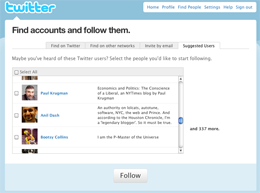
Twitter's Suggested User List works in a fairly simple way. When a new user signs up for Twitter, they're presented with a list of about 20 "default" accounts to follow. These recommendations are a random subset of a full list of over 400 suggested users. In addition, the full list appears on the Twitter site itself, so if any user clicks on "Find People" at the top of their Twitter page, they're only one click away from choosing to follow some suggested users.

It's obvious why the team created these suggestions; If you just signed up for Twitter and weren't following anyone, it'd be a pretty boring service. Social applications have provided plenty of precedent for the practice of suggesting content or connections, but Twitter's exceptional success and the fact that tweets are seen more as a new medium rather than merely a feature of the Twitter service have made the suggested user list into a polarizing reminder of the company's power over the service.

What's not obvious is why I was picked as a suggestion. I have a number of friends at Twitter, including about half a dozen let's-grab-dinner-when-you're-in-town level of friends. As Biz noted, I was an early an enthusiastic fan of the service. And I'd like to think I'm not a terrible tweeter — my updates are a mix of interesting links that I find, random thoughts, brief reviews/mentions of music and media that I like, and promotion for the projects I'm working on. But I'm obviously not a better tweeter than 99 million other Twitter users, I never asked to be on the list, and it's never been explained to me why I was chosen. Ultimately it's clear that the decision of whom to feature is essentially an arbitrary choice by Twitter , and that at best, I represent something they'd want to show new users.

A list of suggested contacts makes perfect sense when a service has about 10,000 users, to help them get started in an unfamiliar space. But it's a system that starts to strain a bit once a service reaches 10,000,000 members. (Or even, as it appears, nearly 100 millon members.) Of course, the folks at Twitter had no way of knowing they'd leap from a five-digit user count to a nine-digit one faster than anybody else on the web ever has. Combine Twitter's support for user-defined lists on the service and the criticisms of the list that have surfaced, and it's easy to see why Twitter's announced that the list's days are numbered. I'd be shocked if it doesn't disappear entirely in 2010.

So, I don't have any real issue with the fact the list was made in the first place; If I were a Twitter shareholder, I'd fully expect the team to design the best possible experience for new users. (If I were a substantial Twitter shareholder, I'd buy a round bed and fly it through space like Snoop Dogg. But I digress.)

I do have some misgivings about the effect of the list, though. In addition to showing how much control Twitter has over the medium they've created, the list also causes some pretty uncomfortable and awkward distortions. It conveys remarkable privileges to the few hundred of us who are members. A lot of celebrities, some past their prime, have pointed to their enormous numbers of followers on Twitter as evidence that they still command some sort of passionate following online. Other nascent talents have had their profiles raised by becoming "Twitter stars", with their thousands or even millions of followers held up as proof of strong demand for their ideas.

A Dutch kid sold his Breaking News account to MSNBC, and Kim Kardashian is famously selling her tweets for $10,000 a pop. But I've been able to determine that having hundreds of thousands of Twitter followers is basically only a measure of having been on the suggested user list, and doesn't consistently indicate any intent from Twitter users at all. So, not to take away from Breaking News or Kim Kardashian, but there are people making a significant amount of money simply by virtue of having been on the suggested user list.

And it turns out, those suggestion-heeding followers might not actually be paying any attention at all.

The Power of Suggestion

I had no advance notice I was going to be added to the list. I went out for coffee with a friend, and returned to find a few hundred emails in my inbox, all of them notifications from Twitter that someone had followed me.

To my surprise, and to the disbelief of nearly everyone who's asked me about it since, I wasn't immediately excited or thrilled to have won the Twitter jackpot. For the first weekend, I wasn't sure what to do with all these new followers, and I didn't update my status at all for 2 or 3 days after I first got added to the list.

Now, that's pretty unusual behavior for me — I've been blogging for ten years, and I'm fairly public within the tech industry. I don't get nervous standing in front of thousands of people when speaking, and over the years my blog's gotten a pretty significant number of subscribers as well, yet I never had any similar concerns here. So what changed? Well, I tend to use social services in a more personal way than my public blog post. And, honestly, the sheer rate at which people follow a suggested user on Twitter's list is overwhelming. Let's look at the velocity with which a suggested account accrues new followers.

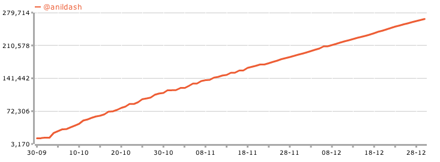
Here's a chart of my new followers, courtesy of TwitterCounter;:
anildash-follower-chart.png

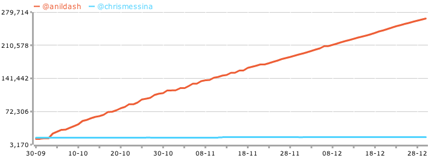
The small flat area at the extreme left of the graph is what my growth rate looked like before I was on the list. It doesn't seem like it, but that was actually an uncommonly high rate of new followers. For contrast, I did a comparison with Chris Messina, who accrues new followers at about the same rate I had been, writes about similarly geeky topics as I do, and actually started wtih more followers than I did:
anildash-follower-comparison.png

Yes, compared to being on the suggested user list, a very popular normal Twitter user's growth looks pretty much flat. That's how different it is. Nevertheless, after a few days of being on the list, I decided I was going to just tweet the same way I always had, and not overthink things too much.

Finding Meaning

People who accept the suggestions of the list are almost all new Twitter users, and have barely formed a model of how Twitter works. In some cases, due to the extraordinary amount of hype around Twitter, they've barely formed an idea of how the web itself works before signing up for Twitter and becoming one of my ostensible followers.

There's precedent for this sort of "bundled content", of course. The crappy "shovelware"; programs that come with most Windows PCs are a perfect example — they often nag users, are frequently of little value, and often detract from the experience. I often update with non-sequitirs about stuff like peanut butter jelly time, so I have to imagine that a regular Twitter user seeing my updates must see me like a notice that their new Windows computer has cleaned up the icons on their desktop.

Of course, services like Amazon and iTunes feature content as well, but these are usually pretty straightforwardly analogous to endcap displays in retail spaces like a grocery store or Walmart; The stores sell placement and brands that want exposure pay for the real estate.

After just a few days of being on the list, though, I made an interesting discovery that offers a dramatic distinction from buying featured position in an online store: Being on Twitter's suggested user list makes no appreciable difference in the amount of retweets, replies, or clicks that I get.

Once in a while, I get confused replies from people asking who the hell I am, but for the most part they don't interact with me at all. The replies, retweets and conversations that happen for me on Twitter have the same frequency and volume that they would have had if I'd never been added to the list. I'm sure celebrities (whether on the suggested user list or not) get a disproportionately high number of people trying to catch their attention, but for a normal person, being on the list just adds followers, not real connections.

Twitter followers who come from the suggested user list don't form real relationships or respond to the suggested users like "normal" followers do. If I'd have continued gaining followers at the rate I had been before being on the list, I'd have about 10% as many followers, but I suspect I'd have exactly the same number of replies and retweets. Before being on the list, a typical link that I tweeted would get between 250 and 500 clicks; After being on the list that hasn't changed at all.

And for me, that's a little off-putting. I feel very much like I've earned the readers who subscribe to this blog. When I meet someone at an event and they tell me they've read a post of mine, or that they regularly read my blog, it's still a thrill, even after a decade, because there is some core sincerity to the exchange, a real basis to the relationship. With Twitter, it's hard for me to tell whether someone's made a decision to follow me because they find my ideas interesting or entertaining, or if they just were too lazy to change the defaults when they signed up.

I'm not complaining; I know a lot of people would love (or think they'd love) to be on the list. I've had some remarkable bits of serendipity, like my next door neighbor discovering me on the list. But I also missed the notification that my cousin was following me on the service because there's too much noise for me to turn on notifications. For the way I use the web, I value meaningful connections much more than I do sheer volume of followers.

Adding to the feeling that these aren't "real" connections is that almost nobody has gotten more than 200,000 followers or so without being on the suggested user list. I'd be curious to know the most popular account that's never been on the list, but at the very least the combination of prominently featuring follower count as a "score" on people's profile pages while also having the only path to earning a high score being an arbitrary selection through an opaque process is a recipe for leaving a lot of people frustrated or mystified. Indiscriminate followers might be of some value for a business that just wants to have a lot of people to talk to, but for an individual, being on the list only has value to those who want to brag about the number. I'll admit I've been tempted to use my follower count as a credential in my work lately as it's taken me to less tech-savvy corners of Washington, D.C., but the fact that the number is meaningless made me feel it'd be dishonest and would misrepresent my actual influence.

Because I've been privileged enough to be on the list, I've tried to use the power for good. I am very happy that I'll be able to promote my work with Expert Labs to a larger audience, though I don't think I have any way to translate this audience into followers of @expertlabs. I have also tried to promote worthy efforts by my friends or to support charities. But there's also generally a continuous stream of requests from spammers and schemers and just plain icky hustlers who want, expect or even demand that I promote their work to my large follower base. Explaining to them that these followers don't click on links, reply or retweet requests does nothing to dissuade them, unsurprisingly.

So if I had a choice in the matter and knew then what I know now, would I choose to be on the list? I'm not sure, but I think probably not. But, since I am, I wanted to try to do something interesting before either the suggested user list disappears or I ask (As Jay Rosen did) to be removed from the list.

Open to Suggestions

I want to see what interesting information we can tease out of my place on the suggested user list. There are a number of questions that immediately pop to mind, which I don't have specific answers for:

  • Has the rate of replies or retweets per day (or per week) increased as much as my follower count has?
  • Do I get more favorites from users, proportionate to the number of new followers?

I suspect there are lots of other bits of data that I think could be compelling, and the good news is that we might have a way to process some of that data. I've been running Gina Trapani's smart little Twitter application ThinkTank (formerly Twitalytic) since before I was added to the suggested user list. The app can pretty easily be customized to return whatever data queries we're interested in. As a result, I have an archive of all my followers, tweets and replies going back for months. So I'm proposing a simple contest to solicit ideas for what information people are interested in mining from the account of someone on the suggested user list, and I'll provide a prize to one random person who suggests an idea, as well as one random person who contributes code to help.

Here's the prizes and how to participate:

  • Have a question or specific bit of data that you'd like to know about an account on the Suggested User List? Submit it to Twitter with the hashtag #sulidea and one random person who makes a suggestion will get a $25 Amazon gift certificate.
  • If you're a programmer, watch ThinkTank on GitHub, commit any updates you have to the project, and one random person who commits code to the project will win a 500 GB portable hard drive. It's really cute!

I'll run the contest until January 15th, and then just pick a winner at random from people who tweet or submit code. I think there's great potential to discover some surprising insights about how the suggested user list really works.

40 Comments

Just because someone says YOU NEED TO FOLLOW A PERSON will i ever always follow someone.
FOR ME what happened is... I got the list. I looked at the profile of many people. I decided based on the profile & reading their past tweets would they be great for me to follow. THEN i checked FOLLOW ANIL [at the worst i could poke him every so often like TIM: I just saw Anil at the menes room the other day. BOB: Did you happen to see what he was doing in the mens room? TIM: Yeah i did... He was looking at his ANIL]
OK enough poking....

Great post -- it pretty much confirms everything I suspected about that list.

As far as who's gotten the biggest withOUT being on that list, I know this.

Before Ashton was all over the news for hitting 1MM followers very few celebs used the site or had much of a following. My business, @FLWBooks, peaked at ~70th on the list of most popular twitters.

I actually carry that as a point of pride in that every single person above us was a celebrity (Ashton, Kardashian, Paris, etc), known brand (CNN, NYTimes, Whole Foods, Jet Blue), or media figure (mostly techies who have G4 shows or some such.) My brand, on the other hand, climbed up there solely on the strength of its utility.

I continue to grow at a nice clip -- I have over 75k followers, but I've noticed that clickthrough on my links has actually *dropped* quite a bit.

I suspect that the average # of people an individual is following has gone up dramatically and therefore any one tweet scrolls away much more rapidly. Combine that with that many more links being tweeted. And then move a huge number of those followers onto iPhone clients where clickthroughs on links are much lower.

Add it all together and the utility of Twitter -- for an individual or business -- has dwindled quite a bit in 2009.

Peter Steinberg
(The guy who runs Flashlight Worthy)
http://www.FlashlightWorthyBooks.com
Recommending books so good, they'll keep you up past your bedtime. ;)

Yeah, Anil, I've found a far better measure for seeing relevancy/engagement/audience love, etc, is how many (and what) lists you are on. These haven't been gamed yet, either by the SUL, or by the industry that helps people get Twitter followers even though they haven't been earned by doing great content.

I hate the SUL, though, because it messed up the follower numbers and gifted large audiences to people (many people think that having lots of followers is more important than anything else and for some, like Mashable, it was a huge gift that they DID turn into a sizeable engaged audience).

This reminds me closely of the Mark Twain story of a man getting into heaven, where, after some misadventures, he is handed a harp by a guy walking away. He plays the harp for a while, and then realizes how boring it is, but it meets his conception of heaven.

He goes off and does more interesting things.

Peter: who has gotten the biggest without being on the list? I believe that's "shitmydadsays" who got several hundreds of thousands of followers without being on the list (I believe).

Leo Laporte was the one who had the most followers before the SUL came along, though, and he has never been on the list and now has 153,152. I believe he was kept off the list because he kept threatening to sue Twitter over its trademark (he owns the trademark "twit" which he defends vigorously).

Nice post, it confirmed mostly what I thought. If you want to use Twitter as a two way communication device and not just a bullhorn, then being a suggested user maybe more a detriment then a help.

FWIW, your feed was one of the defaults in FeedDemon 1.6, which I installed back in 2005. I never unsubscribed, but it was more out of curiosity than laziness. Never underestimate the power of the butterfly effect. (Oh wait, that was an Ashton Kutcher movie, wasn't it? Never mind.)

I learned a lot from this post. If Twitter were to ever add me to the list I would ask to be taken off for the reasons you suggest: It does not increase engagement of followers. Thanks for the insight into the SUL.

Your blog commenting system doesn't offer Twitter authentication as an option. Have you gotten many requests to add it? If not, I guess that is another bit of evidence the massive influx of SUL followers isn't interacting very much.


I sent an #sulidea as a tweet, but I'll mention it here as well. I think it would be interesting to know the percentage of your followers who are still sending their own tweets a week after following, a month after following, etc. We know a reasonable percentage of people don't use the service for very long, it would be interesting to get a feel for the shape of that graph.

I'm totally new to Twitter, and this is really interesting. I don't think I'd ever have read this had it not been 'suggested'.

I second Denton's suggestion, I think it'd be quite telling actually.

I used Twitter very rarely until I started running a site I wanted to promote - I then used it often over the time the site was live and gradually accumulated what appeared to be relevant followers. I didn't notice very many clickthroughs though and decided it simply wasn't working for my niche, so stopped tweeting, and haven't logged onto Twitter in a couple of months now. I suspect there are many, many others like me who "dipped their feet", found it wasn't for them in whatever way, and went on their way. Despite its apparent phenomenal success I believe Twitter is very much a niche tool.

Re: your point about Breaking News (The Dutch kid) selling his account to MSNBC, SUL or not, his account provided an unparalleled and up to the second stream of important and breaking news. When the San Francisco Chronicle announced it would cease its print publication, the news was published on Breaking News more than one hour before it appeared online in the mainstream press. You're right about quantity vs. quality though. More genuine engagement from followers could be much more valuable in financial and intangible terms than having an enviable number of followers. Happy New Year! @Chikodi

It's a nicely written article, Anil, but you seem to be overlooking a key point.

The reason why "Twitter's suggested user list makes no appreciable difference in the amount of retweets, replies, or clicks" that you get is because, with all due respect, to probably 99.99% of new users on Twitter you're a complete unknown. Even if they sign up to see your updates as promoted by the SUL, they�re unlikely to actually be reading them. Or even notice you at all.

Conversely, when a brand or celebrity is added to the SUL, it�s a HUGE gift because they�re already known to the greater public, and it�s absolutely the first thing new users, who are Twitter-shy but brand-savvy, see. In fact, Twitter, by nature of it being a �suggested user list�, is saying to these new users, �Hey, you know Oprah, right? You know Dell? Guess what: they�re on Twitter too!� It legitimises both Twitter and the world that the user knows.

Moreover (and I believe I�m still correct here, although it�s been a while since I set up a new account), the twenty users that are suggested are automatically ticked � you have to unselect them � so most newcomers, many of whom aren�t especially tech-savvy and/or confused at this moment in their Twitter experience, just go along with it.

Now, for folks like yourself, that�s likely the end of it for them. But when it�s Britney Spears, or Wholefoods, or Ashton, or Coldpay, or John McCain (!), or Threadless (who gained massively), or TIME, or Wired, or the New York Times (and staff), or Mashable, or TechCrunch, or CNN Money, or TV Guide, or JetBlue, or the many sports teams on the list, these all have a major financial interest in being part of that recommendation process. And when their little avatars start scrolling down these new users screens, they will pay attention. They will click on their links, and they will retweet. You just have to look at the most retweeted users on Twitter to see the obvious correlation between numbers of followers and number of retweets, and the bulk of the most-retweeted are on the SUL.

Now, don�t get me wrong � the big celebrities and super-brands likely would have attracted plenty of followers ultimately, anyway. But then why gift them the SUL from day one? If they�re already famous, why do they need the extra attention from Twitter? How is that fair to everybody else who Twitter deems isn�t worthy of their very insular and inconsistent boys club?

And did we *really* want to give MC Hammer another chance at a career? ;)

What I think you have to ask is � could I have picked up all these followers by myself, simply on the back of my existing name and profile and the things I�m writing about? And if the answer is no, then it�s a gift. Even if you�re seeing only a marginal increase in retweets and attention, your profile within Twitter, simply by virtue of your increased ranking, has increased exponentially. Because even if you (wisely) don�t believe that the size of your follower number equates to the size of your importance, a lot of people do.

Here�s the thing: on paper, I�m all in favour of a suggested user list, assuming it�s done right. What I�d like to have seen is when you signed up to Twitter they asked all new users four or five questions about their interests, politic views, hobbies, etc, and then suggested twenty users (from a pool of tens of thousands) on the basis of that.

I�d even then accept another 10 users who paid to get a spot on that list. I�ve written about this in length before on my blog, but if Twitter charged $1m/year for a spot on the SUL, and suggested these folks alongside a number of other calculated-yet-still-random recommendations, everybody wins. Twitter gets another income, the brands and super-celebrities can buy their gift (which for Mashable and many others is worth a lot more than $1m), and everybody else gets a chance at picking up a little extra attention.

As it is, I hope the entire thing is scrapped in 2010. The sooner the better. And part of me kind of hopes that, Fight Club-style, and however unlikely, somebody accidentally presses the wrong button at Twitter, everybody�s follower count is wiped back to zero, and we all start over. :)

It's too bad most people have written their best posts of 2009 lists already as this certainly is a piece worthy of consideration.

One thing is perfectly clear, you never could have expressed this opinion effectively in Twitter itself. When combined with the superior indexing quality of blogs, I think it's pretty clear that history is again repeating itself. As such I repeat what I said at Wordcamp Chicago 2009, by 2013 Twitter follower count numbers will likely fall in importance significantly just as RSS subscribers numbers or Technorati link counts did after their peak of importance.

As for your current blog commenting system, I need to mention how lame it is. Blogs are supposed to show the links to other blogs not social media account pages. As you were a former blog product manager, I'm disappointed with your current choice.

Thank you,
David
http://www.daviddalka.com/

I hope this doesn't sound spammy, but since you said that want to use your powers of influence for good, maybe you could tweet about the project I have recently started on twitter. It's a collaborative writing project aimed to bring discussion and awareness to the topic of human trafficking. See my profile @OneTweetFiction for more details or read the story so far at http://www.stopslaveryworldwide.com/story/.

Thanks,
Matt

One thing that is probably implicit in your article -- but never actually said -- is that many Twitter "users" aren't even users, from a practical standpoint (as is the case with any free service, really). If someone signs up for Twitter and registers activity on the service less than once a month or not at all, they aren't really a user. One nice thing Facebook did with their application stats awhile back was to show you not just how many installations you had but how many *active* users of your app you had. I'm not sure they ever exposed how they calculated what was considered active, but the specifics of the calculation didn't really matter that much.

So essentially, what the SUL does is that it inflates your follower count not just with people who don't know you well, but also with people who don't even use the service. I'd bet a dollar that a large percentage of your SUL-gained followers aren't just ignored your tweets... they aren't even seeing them! My bet would be somewhere between 50-80%, in fact.

If I were Twitter, I would be paying heavy attention right now to creating the next iteration of PageRank. PeepRank, you might call it. It would be a measure of who is really the most influential on the service. It would start by analyzing follower quality. How many followers do you have who use the service every week? How many followers do you have with at least 1000 followers themselves? How often is your stuff retweeted? Etc etc. That sort of thing is a lot more interesting than a straight follower count.

RE: Gaming of Lists

Signing up for twibes.com and adding yourself to popular categories such as socialmedia will pump up your list count on Twitter and ruins that as a metric as well.

This sounds like yet another business model for Twitter - people could pay to be on the suggested list on a per hour or per day basis.

Its fascinating that - despite its superficial similarities to the "broadcast model" (i.e. a radio or tv program) - people with a large following don't necessarily have all that much response from the content they create (i.e. tweets). It thus goes to show that there's a lot of room for marketing strategy to evolve vis-a-vis microblogging sites like Twitter.

Robert-

Agreed, "shitmydadsays" is now the reigning king of organic follower growth -- it passed 1MM followers in the mast few days. And it's well-deserved. It might be the funniest thing on the web right now. That said, it's working with a *much* larger audience and a media climate that pays a lot of attention to Twitter memes so I don't know if it's an apples and oranges comparison to @FLWBooks.

As far as "Leo Laporte was the one who had the most followers before the SUL came along" -- he may have been at the top of the rankings, but to me he's not any different than most the others that outranked me -- he had, and still has, a large and well-known online presence via TV shows, Podcasts, guest columns, etc.

As Anil kindly points out, getting on the list grows your numbers but the value of that growth is bordering on nil so any discussion of who's on the list is a bit academic to me. It just burns me that Twitter continues to suggest the people that they do. The list is overrun with unengaging celebrities, dozens of tech bloggers, and no offense, but way too many Twitter employees.

Who should be there instead? Well, of course I think I my account should be. It's engaging, useful, has real community, is completely different from the 200 accounts there, etc, etc, etc, blah, blah, blah. Most important, the growth of my business -- almost completely through Twitter followers -- is a real success story for Twitter. You'd think they'd be giving it a bit more play.

Who else? Well, it would take some balls, but ShitMyDaysSays deserves it. And a good number of restaurant chefs (@Gachatz). And food writers ( the recently dethroned @ruthreichl). There are great authors tweeting (@neilhimself). How about some of the treat trucks that tweet? Obviously they'd likely not be in your town but if you saw one you might realize that the restaurants and food carts in your town tweet.

I could go on and on -- the real point is that it would all of about 4 hours for someone at Twitter to clean up that list. That they continue to ignore it with the excuse of "it's going away soon" is doing a real disservice to the millions of new members they acquire every month.

Peter Steinberg
(The guy who runs Flashlight Worthy)
http://www.FlashlightWorthyBooks.com
@FLWBooks
Recommending books so good, they'll keep you up past your bedtime. ;)

Hey Anil,

I have three experiment ideas for you.

1) Ask people to click. Something like, "Hey, a quick favor to ask: please answer this 30 sec survey. Will share info ;)"

I posted that exact note, at approximately the same time, on Twitter, Friendfeed, and Facebook. On Twitter, for example, I had a 2.78% action rate (people clicking through and taking the 2 question survey).

2) Even simpler: Don't require a survey at all. Though this is hugely subject to gaming, you could simply post on Twitter, "Are you actually reading this tweet? Please click here to confirm [bit.ly link]"

3) More complicated but more interesting: Post something along the lines of, "I'd like to get to know my readers! Mind briefly introducing yourself? [bit.ly link to Google Docs survey, asking folks how they know you and inviting them to add a one-line hello].

When I did this latter experiment, I was surprised and a bit bummed to find that the vast majority (I think around 95%) of the respondents were geek friends of mine in real life :(. This demonstrated to me that the huge majority of my followers on Twitter followed me not because they were interested in me personally or particularly interested in what I tend to tweet, but just happened to follow me because I followed them, or they saw an isolated tweet of mine, etc. And from what I recall, fewer than 0.2% of my followers responded.

In summary... Twitter: A lot of people there, and barely anyone really paying attention.

Thanks I have gained a lot from this post..now I have to see how I can apply this to my benefit...anyways happy new year to you...

Anil. There is another option, granted you have that kind of time. All those followers did make a conscious choice to start following you. If you want more engagement from them, you should engage them more yourself.

Anil, I can totally see your point. I remember being at a social media conference where the suggested user list came up a few times. People were wondering how the list got made and how Twitter staff chose people.

It's mostly noise, and it's people you'd otherwise not follow. A lot of the comments here point to that. A lot of new users sign up not really knowing much about the service and a lot of users never really get into it. The fall off rate is pretty steep.

I opened my Twitter account back in 2007 way before the buzz hit. There was no suggested users list then. Then members could run a search to find people to follow. That's long gone as people started to game that process too, and Twitter got rid of it to discourage spammers.

I've opened a few new accounts for my social media clients, so I've seen the suggested users list. The list has people who are usually famous or have otherwise made it to the Twitter staff's radars (as mentioned, a few are Twitter staffers).

That's nice and all. However, who cares unless you're just on Twitter to brag about how many followers you have? What people don't mention is that for a big number of their followers their tweets are just noise that is ignored, and that's assuming these followers bother to log in and pay attention.

There are some great ways that the list could maybe work better. Maybe have people choose their interests, geographical location or other factors and suggest users from there. It just seems that a generic list of random people isn't going to do much but pump up their numbers.

Doesn't this form of monetizing Twitter fame boil down to old fashioned, Madison Avenue, "interruption marketing?"

If the Twitter followers don't give a damn, find some companies which you make believe they did.

At least it seems to work for some markets/niches. Buy enough ads until someone will buy from you.

I left a couple of suggestions for your contest on Twitter.

Yours
John
Happy 2010.

Congratulations!

I want to be like you.

I loove this prhase,

Follow me and I follow you

http://twitter.com/BancodeImagenes

You have a happy new year 2010.

Anil,

Thanks for sharing your observations from the other side of the wall so clearly. This post cleared up the issue of whether engagement was dropping off on Twitter or not for me for good. After some telling Hitwise data that showed up on Bill Tancer's blog about 2 months ago I had a feeling that there was a shift happening on Twitter where everyone has continued broadcasting, but has stopped listening. I wonder why that is (is continually drinking from a fire hydrant of tweets too exhausting for us perhaps?) Anyway - There's some great data that might explain and validate what you're feeling here:

Bill Notices The Drop:
http://weblogs.hitwise.com/bill-tancer/2009/09/twittered_out.html

Bill Points Out The Drop Continues:
http://weblogs.hitwise.com/bill-tancer/2009/10/twitter_revisited_in_more_than.html

My Post On The evolution of engagement (112 Tweets so far).
http://blog.steffanantonas.com/focusing-on-value-how-im-changing-how-i-use-twitter.htm

Good luck with this, Anil. I now have 1,089,793 followers on twitter.

My @ replies increased tenfold. Most of those replies are people asking me to follow them, pimp their band, buy their product or have sex with them.

A good portion of those followers are "empty" accounts; people who haven't posted since joining, spam bots, people who just want to follow the top listed twitter users in the hopes you are a celebrity and will put in a good word for them with your agent.

You will get a lot of of "Who are you??" replies because how can you have that many followers if you're not a celebrity? You will get a lot of people telling you that you weren't worth being on the suggested users list.

For me personally, the increase in followers did not mean an increase in stars. But it did mean and increase in retweets, most of which were mangled in the process. If you're tweeting with humor, you'll realize quickly how literal most of your new followers are.

I don't want to sound ungrateful, but being on the suggested users list did not in any way enhance my twitter experience. It has made it frustrating at times, infuriating at other times and has left me feeling like I owe the people who follow me something as if I was some kind of stage act, when all I wanted from twitter was to have a little fun with a small group of friends. Instead, I get people pissed off that I'm not following them back, berating me for not being funny enough or not being deserving of the follows I have, people yelling at me for not replying to them. The signal to noise ratio of the replies to me is, well, noisy.

I did find some really interesting people to follow in the process but overall, the experience has been a bit negative.

I really think twitter should ask people "Is this something you want?" before they add them to the list.

Happy New Year Anil! I hope to see you soon.

My thoughts after reading this post are:

1) This couldn't happen to a nicer guy.

2) How many followers do you have to get before your friends at Twitter verify your account? Or does that not matter at when you make it on the Suggested User List?

I think your thoughtful post explains why you got chosen to be on the list. Not surprising that Quantity doesn't equal Quality when it comes to followers.

I have tried many ways to grow our follower list with the goal being to find people on Twitter who are Zig Ziglar fans, since we use Twitter to bring people back to the Ziglar blog and website.

The four ways that work the best:

1. Tweet a Ziglar quote, then key word search the name Ziglar and follow those who quote Ziglar. A lot of work, but good quality results.

2. Posted the Ziglar Twitter strategy on our blog telling people how we grow. Gives value and links the social media people who are also Zig fans.

3. Create a good blog post about Ziglar and Twitter that gets picked up by a trusted social media expert.

4. We created a viral 2 minute flash movie combining famous Zig Ziglar quotes and our Ziglar Twitter Philosophy with the landing page being on our Twitter page. This is easy to RT and the Zig fans love it and they usually stay and follow. Those that don't know Zig also have a favorable impression but they don't necessarily follow, which is fine. You can watch the movie at http://budurl.com/ZigTwitter

I found you through Seth's post today. Thanks for giving me some valuable information on your Twitter experience.

Well said. I have a disclaimer on my twitter page that reads "I don't do reciprocal follow. My goal is to have those who chose to listen. Follow only if you like to be notified of my blog updates. No disrespect meant to you. Thanks for your understanding"

I thought i was arrogant enough to do that, but hey those who appreciate quality do choose wisely. Don't they?

Have a look at my profile @nibrasbawa. Relatively small gievn i started only recently, yet a committed lot..... :)

www.nibrasbawa.net
Twitter @nibrasbawa

There is a serendipity-esoteric aspect of twitter, not be underestimated with all the twitdata gathered by the various apps, going even beyond the strong human need for belonging, wishing to be in the in-crowd, in-the-know, or followed by the thousands. I joined twitter almost a year ago as a personal experiment to write once a day about the burnout I was experiencing after 40 years as a nurse. I figured that I could at least come up with 140 characters out of my depleted energy state. So, it has become a daily meditative practice. I accept that maybe just one person (a real human twitter follower) is supposed to come across this daily blip for a reason that I won't know. Sometimes the burnout blip is retweeted by 3-4 people, small potatoes to most. Twitter is more than we think it is or what twitter thinks it is. Daily I find a tweet (out of the billions) that is just exactly what I need to hear at that moment.
[@thedeeperwell on twitter]

As you may know, the standard operating procedure for many people to build a following on twitter is to send follows to a selected group of people and assume that a certain fraction of people will follow you back.

One way to get a targeted audience is to poach the followers of another user. Sometimes you get a very high response rate this way, for instance, there's this guy @besserweber who has 80k follows and followers, but has never made a single tweet. Pretty obviously anybody who follows @besserweber follows anything that moves -- just about 100% of them will follow you back, but they're useless, probably not even human.

If you do this with a twitter user who writes good tweets, maybe you get a 20% response rate, and they're actually pretty nice. They certainly click, RT, ask questions and are engaged.

If you do this with a twitter user on the suggested list, say @timoreilly, you get a basically 0% response rate. My guess is that a lot of these people don't have any idea of what's going on, and probably many of them never actually use Twitter.

Great post, Anil. So interesting to hear about someone's experiences on the Twitter Suggested Users list. I always found it troubling the "Old Boys Club" phenomenon of Twitter Suggested Users, in that they're so arbitrary and carry with them such enormous weight. But I'm glad that there are people like you that feel the same way about it.

I truly wonder if you get a proportionate amount of engagement (i.e. users retweeting, replying, etc) with the number of followers you have. Because I have to imagine that a great deal of those followers are spammers, or random people who never really check back. Or even lurkers. I would have to imagine that the majority of people who added you initially were genuinely interested in what you (specifically) had to say. I wonder if that's the same about the people who follow based on Suggested Users.

Anyway, thanks so much for this post! Very interesting.

Not sure when I started following you (pre- on the list or post), I only just noticed the suggested list last week, and selected a few more people to follow.

I do know it was about the time you were doing a roast for someone and I asked if you were always this annoying. Thankfully you weren't.. but I haven't noticed your tweets to be particularly standoutish in any way (not that there was any expectation they would be or wouldn't be, since twitter is used as the twitterer sees fit), so I assume the reason you got added to the list is the same reason you're working for Obama now: your status as an internet name.

I enjoyed reading about your reactions to being on the list, and how it does not fit in with your use of twitter to make meaningful connections. I don't use twitter to make any meaningful connections as of yet, since most of my associations are outside the hive (by hive I mean everything social internet), so I'm really just going through the motions out of curiousity about what this thing is.

And I have a different question, I'm not a follower of your blog, but I've noticed on several popular blogs, obvious spam such as
==
[spam link removed - ad]
==
is not removed from your comments. Is this a little fad thing, or what?

Would be cooler if I could win the half Terrabyte drive for an idea, however, an Amazon gift card is quite possibly ok :)

Thanks for posting this Anil. As a fellow, seemingly random member of the SUL I agree with what you wrote.

There was an initial flurry of news stories over the summer about my huge number of followers but things have since calmed down. Now I try not to mention it because I've noticed that people start behaving oddly towards me when they find out. I try to be diligent in saying upfront "I'm on the SUL, that's why I have 1mil+ followers" but I can almost see people change. They are suddenly extremely interested in everything I have to say. Conversations start to feel fake. They want me to tweet things for them, or to give me free stuff.

I had a career before Twitter, sold just as many CDs and licensed just as much music last year as I'm doing now, so I've been going on in my normal way and tweeting/blogging like I always would. SUL or no SUL, Twitter is an awesome tool for me to talk to my audience, get the word out about concerts and record releases. Its also just an excellent forum for me to express myself, whether I'm on tour, or at home up in my cabin in the woods making music or pancakes.

I've been expectng the SUL to go away for months, and I expect it will disappear soon...and then I'll go back to being irrelevant again. However, its been a very interesting and entertaining 15 minutes. I've enjoyed this tiny opportunity to subvert the dominant culture ;-)

Anil - GREAT article. I'm wondering if you're aware that Twitter announced today that they're changing the suggested users list - essentially, they're going to ask new users what they're interests are and then dynamically match them to users who tweet actively about those topics.

How do you think this change will effect "Life on the List?"

Great Post! I have written extensively about how those who don't follow back very quickly sacrifice the best followers and definitely the most engaged people who would RT and comment. It takes any engaged social media newbie about two weeks max to understand the basic dynamic of social media: that it has to be base on mutuality to be real - otherwise why not surf Google or watch TV or...read a dinosaur newspaper.

Many on the SUL never got a chance to learn this dynamic because they had the opposite problem (they were suddenly made the equivalent of the old TV announcers instead of newly finding themselves members of an audience that could interactive and find mutual connectivity with the announcers).

The dynamic of expecting mutuality for things to be real is not based so much on petty emotions (I won't like you if you don't respect me as much as I respect you) but on logic and self-confidence (why should one believe that, over time, a Twitter's insights will be on the mark if they aren't interacting with followers and only reading an insular selection of the same people on the SUL).

So, if you don't follow a newbie back, many of the more engaged and self confident ones will unfollow you after two weeks when they realize you have no intention of following back. If you don't follow someone back who seems like they know what they are doing and follows 2000+ themselves, they must, by Twitter rules, unfollow you in order to grow by following others (Twitter won't let you follow new people if there is a chunk of approximately 200 people you follow who are not following back once you are following 2000+ people).

This is clearly why you are not seeing much interactivity from those that remain. Interactivity normally doesn't begin on social media until the mutuality has taken place.

Brands simply cannot afford at all to refuse to follow people back. Pepsi understands this well. United Airlines, when I checked two months ago, did not.

Paul, above, mentioned that smart Twitterers quickly learn that the best way to get a quality, targeted following is to poach (cross follow) quality followers of successful (on their own merit) accounts (or better: follow those the owner of that account selectively follows if that owner is selective but not overly so) that deal with the same subject matter. In practice, this means that you follow a few hundred ppl from a few of such accounts all at the same time, quickly reaching your follow limit of 2000 people.

Then you wait a week as 75% of that 2000 follows you back. After no more than two weeks, you use a service like Buzzom to flush all 500 accounts that didn't follow back and then you "Cross-Follow" (poach) a new 500 with repeated flush/cross follows every two weeks minimum.

Note that when I say you cross follow *quality* followers, I mean you take the half second it takes to know if their last tweet was on topic or spammy or off topic and only click follow if the last tweet was generally on topic (people who sign off Twitter with Good Night or with a reply to someone that doesn't tell others what the topic was - miss out on getting followed by discerning people who are cross following others).

A major part of the Twitter experience is knowing who unfollows - a simple matter if you follow @unfollowr (which ironically doesn't follow anyone back). One basically unfollows an unfollower unless their timeline says they are doing a mass flush and they intend to follow people back who reply to them.

Anyone on the SUL (changed as of January 22nd, 2010) might want to analyze the massive amount of unfollows they get two weeks after people sign on to Twitter and compare the quality of those who take the time to unfollow them to those who aren't even interactive enough to bother deciding whom to unfollow.

If the highest quality people are unfollowing at a higher rate, this might mean that those on the SUL are squandering their initial advantage by not following 300,000 people back - in which case I contend that their RT and Reply rate would skyrocket.

The argument that following so many people back would create too much noise in one's timeline really is moot because nobody needs to read their raw timeline anymore.

Having said that, there are maybe 10 people who are so important to any given account's topic that I will follow without expectation of being followed back.

@Expertlabs can grow via cross follow of similar but successful accounts and relatively quick follow back of deserving followers.

I tend to block spam followers. I would have 20,000 total followers on various accounts if I did not do this. Instead I have about 12,000 mutually followed followers most of which wouldn't dare post ads for teeth whitening because that could result in an immediate block (I actually won't delete someone who posts an ad now and then if they've posted anything else interesting in the last ten tweets - ironically the way to get my attention is to post an ad and I will read your timeline to determine if you need deleting or not and see your other tweets as a result).

I can tell in seconds if someone's followers are mostly spammers or otherwise a worthless audience. I need to be able to ascertain this in order to know which accounts to bother cross-following (poaching as you will).

One gains a lot of influence by being seen as someone to cross-follow (poach) although a competitor would gain a lot by poaching you if you have taken care to have a clean, targeted follower, follow list.

By the way, for those serious about achieving any kind of targeted audience on Twitter (those who will read and interact), the Twitter 2000 Follow Rule makes organic growth difficult past the 2000 mark for the following reason: You hit 2000 and cannot follow anyone new...wait two weeks to have 1500 followers and flush 500 non-followers and follow another 500. Two weeks later you have 1800 followers, allowing you to follow a fresh 300 after flushing the 200 that didn't follow back (by now Anil and Ashton and Britney are long gone if they did not follow back).

Fairly soon you will be following 2100 and 2000 will be following you back. You can then flush 100 and follow a fresh 200. Two weeks later you will be following 2300 and 2100 will be following you back. Flush 200 and soon you will be following 2400 and 2200 will be following back. By now, you won't be following even your best friend if they are not following back because you have to automate. But the benefits are increased RTs and Replies from those non-spammers who cared to follow (note that you should be blocking real spam followers and not keeping them so you look good - because smart people will see that you are doing that).

Obviously, publishing good content makes things go faster (as does publishing tweets in quantity which I refuse to do because it loses people like Anil as followers who only follow 160 people), but this Twitter Follow Limit dynamic still makes organic growth slow while punishment for non-follow approaches 100%.

You can create a list to read the posts of people like Anil who don't follow back but are interesting to read. You wouldn't be noticing their tweets in your general timeline anyway. One shouldn't, by 2010, still be thinking of preserving your main timeline stream to be readable. That is what lists are for. Quality, interactive audiences have to be mutually followed resulting in a fast flowing timeline that one only dips into like gathering water from a fast flowing stream. You dip into the fast flowing stream to see if your mutually followed audience is generally on topic.

Spam followers will mostly unfollow anyone after 3 days just like serious quality followers will do. People on the SUL seem to have hundreds of thousands of those rare deadbeat followers who aren't smart enough to be "successful" spam followers or serious Twitter users.

Leave a comment