Google's Microsoft Moment
July 9, 2009
I'm not sure Google's new Chrome OS announcement is that big a deal, or that the eventual product that gets released will actually have that much impact, but it's a useful milestone in marking Google's evolution towards becoming an older company with a distinctly different culture than they used to have.
This is, for lack of a better term, Google's "Microsoft Moment". This is the point when the difference between their internal conception of the company starts to diverge just a bit too far from the public perception of the company, and even starts to diverge from reality. At this inflection point, the reasons for doing new things at Google start to change.
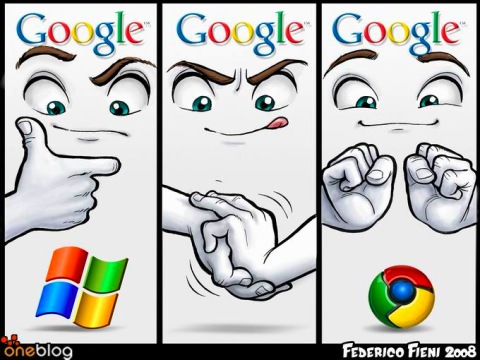
Let me be clear: I don't think Google is "turning evil". Hell, I've caught a lot of flack for the fact that basically I don't think Microsoft was evil. But there are some notable trends going on across Google today that could cause the company to compromise its stated values and that will certainly cause people to think Google is being evil, if not corrected. I'll try to outline a few key cultural indicators from around Google.
Designing for corporate synergy, not for users
Google's recent development work on applications for mobile devices has often been delivered exclusively as applications for their own Android platform instead of as iPhone applications, despite the fact that iPhones are roughly forty times more popular in the marketplace. iPhones are also much more popular outside of the United States than Android, further limiting the actual audience served by these applications. Now, it's obviously good company policy to make sure to support Google's own platforms, and Google does an admirable job of using generic open web technologies where possible to avoid having to choose between platforms at all. But choosing to leave the majority of users in a given market unaddressed because they are on a platform that is not part of your corporate goals is short-sighted and leaves a lingering sense of mistrust.
If you look at Microsoft ten years ago, or even as recently as five years ago, they had a tendency to say "Well, we've got a version that works on Windows Mobile." or "This works on Internet Explorer" and feel that they'd done their job for addressing mobile or the web. Or Windows Media Player would connect to XBox but not to any other systems for sharing media. They were putting their corporate agenda ahead of what the marketplace had chosen as its preferred platforms. But after all these years, Microsoft's internal teams have finally started to develop their web or mobile versions of products to work on competitor's browsers and competitor's mobile platforms, recognizing that they have to go where the users are, instead of favoring only the platforms created by their corporate siblings. Google appears to be headed the other way.
Forgetting what the real world uses, and favoring what's convenient for your own business goals is a quick way to have customers think you don't care, and to indicate to partners or developers that pleasing Google is more important than pleasing customers.
Multiple competing product lines: Chrome OS and Android
This is one of the simplest and most obvious examples, after this week's announcements: Google is now offering not one, but two mobile operating systems. While they undoubtedly share code, I can't help but think back to ten years ago, when Microsoft was vehemently protesting about how much code was shared between the Windows NT/Windows 2000 operating systems and the Windows 95/98/ME operating systems. If I make a screen two inches smaller, should I use Android instead of Chrome OS? If the keyboard works with my fingers instead of my thumbs, I should use Chrome OS and not Android? I know Google is convinced its employees are smarter than everyone else in the world, but this is a product management problem, not a computer science problem.
Changing methods of communication
Within Google, I'm sure the perception is that their public-facing communications are still very "Googley". Now, Google does an excellent job of maintaining and using an enormous number of official corporate blogs in dozens of languages for a rapidly-blossoming number of products and initiatives. But despite my admiration for that effort, and their commendable willingness to forgo the usual boring press releases, the way that the company communicates with the public has fundamentally changed, and not necessarily in a more human direction.
In lieu of blog posts or simple word-of-mouth, as helped popularize the Google search engine itself ten years ago, efforts like Chrome are being accompanied by television ads, complete with all of the production values of primetime TV. Instead of launching a new developer initiative by promoting an SDK on their blog, Google is filling convention centers, Apple-style, with day-long developer presentations and an Oprahesque giveaway of free phones under every seat. Instead of white papers, there are highly-produced comic books being distributed to the press to explain the value of Chrome.
Now, I actually support these types of outreach. Getting outside of the insular tech bubble requires higher production values and clearer messaging. But when Google evokes Apple or Microsoft or Oracle in its style of communicating ideas, and when cell phone ads on TV say "Powered by Google", an average consumer's conception of Google essentially shifts to seeing this company not as "those guys who do the search engine" but instead as another consumer electronics company, like Samsung or Sony, but a little more hip.
This would be okay, except that I doubt Google's internal self-image as an organization has changed to reflect this new reality. "We're not like some giant company with flashy TV ads — we're just a bunch of geeks in Mountain View!" And while that might be true for the vast number of engineers who define the company's internal culture, the external impression of Google being just another tech titan like Microsoft will gain footing, making the audience for Google's messages less tolerant of ambiguity and less forgiving of mistakes.
Only the last generation of companies can be evil, not us!
Though it's almost impossible to picture now, in the era when Microsoft was formed, IBM was synonymous with an almost Orwellian dominance of information technology. It's been a full 40 years since the antitrust actions against IBM, and IBM is seen as a bastion of open-sourceness now, but Microsoft's founding mindset clearly was shaped with the idea that "those old guys from the last generation are evil, and we're the nimble, smart upstarts who are going to humanize this industry". Sound familiar?
Though it's hard to believe, the FTC's first investigations against Microsoft began eighteen years ago. When Microsoft reached its apex in terms of public perception and industry respect, with the launch of Windows 95, the culture inside the company still largely saw themselves as upstarts against old, proprietary behemoths. Though Microsoft's headcount has increased fivefold since then, at the time of Windows 95's launch, they had about 17,000 employees.
Google's headcount just passed roughly 20,000 employees. And most of those staff members are firmly convinced that evil, or at least incompetence, is a trait of the last generation's dominant tech player: Microsoft. The idea that developers or customers might start to bristle at their dominance is met with the (true, yet irrelevant) argument about how open their data and platforms are. Eric Schmidt said yesterday that Chrome OS is so open that Microsoft could make Internet Explorer for it, though of course the effort of porting the browser would be prohibitively complex. By neatly inverting the framing of the conversation ("We didn't bundle a browser with our OS, we bundled an OS with our browser!"), Google's avoided having to confront the parallels between this moment in their corporate culture and Microsoft's similar moment of ascendancy 15 years ago.
Still haven't developed Theory of Mind
And finally, as I outlined two years ago, Google still hasn't developed theory of mind. From my piece then:
This shortcoming exists at a deep cultural level within the organization, and it keeps manifesting itself in the decisions that the company makes about its products and services. The flaw is one that is perpetuated by insularity, and will only be remedied by becoming more open to outside ideas and more aware of how people outside the company think, work and live.
Worse, because most of the dedicated detractors of Google have been either competing companies or nutjobs, it's been hard for Googlers to take criticisms seriously. That makes it easy to have defensiveness or dismissal of criticisms become a default response.
Conclusion
Google has made commendable steps towards communicating with those outside of its sphere of influence in the tech world. But the messages will be incomplete or insufficient as long as Google doesn't truly internalize and accept that its public perception is about to change radically. The era of Google as a trusted, "non-evil" startup whose actions are automatically assumed to be benevolent is over.
Years ago, GMail introduced context-sensitive ads and was unfairly pilloried for being anti-privacy or intrusive. And while there have been a few similar hand-slappings along the way, Google's never faced a widespread backlash against their influence or dominance from average consumers yet. Today, protestations of "but it's open source!" are being used to paper over real concerns about data ownership, and the truth is that open code doesn't necessarily imply that average users are in control.
And ultimately, once a tech company becomes dominant in its space, it's susceptible to a kind of reverse Hanlon's razor: Anything caused by stupidity or carelessness will instead be attributed to malice. Similar to the Law of Fail ("Once a web community has decided to dislike an idea, the conversation will shift from criticizing the idea to become a competition about who can be most scathing in their condemnation."), Google is entering the moment where it has to be over-careful not to offend, and extremely attentive to whether they are treading lightly.
Is Google evil? It doesn't matter. They've reached the point of corporate ambition and changing corporate culture that means they're going to be perceived as if they are. Whether they're able to truly internalize that lesson, accept it, and act accordingly will determine if they're able to extend their dominance in the years to come.
(Illustration courtesy of Federico Fieni.)
Related Reading:
- Google and Theory of Mind, from 2007.
- Google's First Mistake, from 2003
- John Gruber this week, Putting What Little We Actually Know About Chrome OS Into Context
- A Pre-History of the Google Browser, from Chrome's launch last year
- Google Web History : Good and Scary from 2007
Update: There's been a phenomenal reaction to the ideas discussed here. I rounded up a lot of the responses in a follow-up post. But it's also worth noting that a number of people from both within and without Google have pointed out that in many cases, the release of an Android application has preceded its counterpart iPhone equivalent due to delays in Apple's opaque approval process for applications on that platform, or because the Android applications were only created as hobbyist projects by Googlers in their free time. Similarly, a number of people have pointed out significant differences between Chrome OS and Android, such as the primary development environments (HTML5 and Java, respectively), memory limitations for applications, and the distribution model.
While I've certainly not meant to gloss over any of these clarifications as insignificant, and appreciate the additional information, the key argument I'm advancing here is about the overall impact of changes in Google's culture and perception. Many more examples can (and have) been identified to support that larger trend, and I'm pleased that the larger dialogue has focused on that bigger issue, inspiring some great conversation.
5 TrackBacks
� A Day In The Life Of A Twintern � OS X Snow Leopard 10A402 Brings Visual Tweaks and Other Enhancements � ????????9??? � FIA ? FOTA ???? � Sony to release Vaio P 'mark 2' in October � Google... Read More
There have been a lot of great conversations around and about some of my recent posts; Here are some highlights. My post about Google's Microsoft... Read More
If you liked my post on Google's Microsoft Moment last week, you may well enjoy Fred Vogelstein's detailed piece in this month's Wired. I think... Read More
Apple is justifiably revered in the worlds of technology and culture for creating one of the most powerful brands in the world based on the... Read More
Phew! Seems like there are a ton of people talking about the topics we've all been discussing here lately. Here's some highlights: Startup.gov After I... Read More
63 Comments
Leave a comment
- Earlier: At Ten Years, I'm Taking Requests
- Next: All Around The Web

Great post and great points, Anil. Thanks for writing this.
LOL, who is the lesser of all evils is the bigger question! I like your writing style Anil. Google is the greatest source of info on the planet. As the world turns we are going to see huge changes that I believe will be completely driven by the true keepers of the web- US, the ppl!
Big deal or not, they're really strutting their stuff. Evil or not, I think we all have our fair share of being one or the other at some point in time. If anything, Google is ambitious and a power we just can't stop.
Great post, Anil.
As someone who rode the Microsoft wave from the DOS/Windows days, and then followed Google's path from a relatively unknown search engine to its pre-eminence today, I agree with your insights into the cultural changes taking place at Google over the years.
The difference that strikes me is that primarily, Microsoft always played to Enterprises whereas Google has focused on consumers. It takes a much longer period of time for enterprises to switch loyalties, something not true with consumers. MS remained entrenched in companies, whatever the anti-Microsoft consumer culture, and that helped it. Google doesn't have that cushion.
An amazing piece, Anil. Very well articulated.
In retrospect, Microsoft's single biggest and life-changing mistake was the decision NOT to release the Windows source code so that it could be improved upon by the community. I wonder if it was ultimately Ballmer or Gates who decided NOT to release it (and criminally prosecute the people who leaked it a few years ago.)
Law of Fail: "Once a web community has decided to dislike an idea, the conversation will shift from criticizing the idea to become a competition about who can be most scathing in their condemnation."
Guilty as charged. I fell into the trap too many times. We're sheep! BAAAAH.
Important afterthought: Google has been cash-heavy for years. Microsoft had to always consider turning a profit for their decisions and they didn't have a cash-cow like AdWords to fall back on.
It's nice and easy for Google to explore Free-everything alternatives because, well, they can afford to.
Asking Microsoft to give away their Flagship product is a tough decision by any standard.
Like a company who hit the ultimate $Billion Lottery, Google made the 'promise' not to 'be evil.' Almost saying, we know we have more money that you can imagine and we're going to do right by this gift.
Microsoft never really had that opportunity.
Or did they?
Matt, thanks for sharing the link with other Googlers and for understanding the positive spirit with which I meant this. As I said above, this isn't about "evil" or anything like it, it's about recognizing where a company is in the evolution of its public perception. I think the people like you who are listening can make a big difference to how this plays out.
Hi Matt,
I believe google is not only after making profit having said that microsoft in the other hand has always been looking to make profit over every thing they did.
I don't understand. The iPhone version of Google's applications is nicer in many ways than the Android version, yet you write that Google does not have an iPhone version.
Here's the link to Google's Sync for iPhone.
Spot on, Anil! I tweeted (http://twitter.com/LLiu/status/2558498615) my very similar sentiment just a couple of days ago: "I've seen ChromeOS FUD vs Windows movie before: Windows FUD vs OS/2 in 1994. Google = old MS. MS = old IBM. History repeating."
Great article. I was actually thinking the same thing recently when real estate search was launched in Australia.
It's all well and good to release free applications and services but it is easy when you have a cash cow like adwords funding these developments. For other software developers it can be disheartening to develop things like realestate.com.au or domain.com.au and then have a large corporation like Google release a free service that could take a share of the market.
This reminds me of when Netscape was around (and you had to pay for a browser) and Microsoft released a free browser.. essentially dominating over netscape.
I am not saying that these things are wrong and I strongly beleive it is great to develop new services and push the industry forward. It just seems unfair that Microsoft gets so much negative sentiment by people in the industry who follow Google and Apple because they are 'cooler' companies. At the end of the day Google, Microsoft, Apple, etc. are all existing to make a profit and push the industry forward at the same time.
I think it's time for people to realise that Google is not the 'underdog' it once was. They release great products just like Microsoft and Apple do and they also make mistakes like Microsoft and Apple do.
Also in regards to the post about Microsoft releasing windows source code, I think it is pretty arrogant of the community to demand a company release their software to be open source. Open source has it's place but I also beleive that there are both positives and negatives to open source.
As a developer myself, I don't release my code as open source as the years of hard work, late nights, etc. to develop it gives me the potential to create a product the way I want it to be and carve out my own niche in the software industry.
Some things may be open-source, but the important stuff (search algorithms, gmail, etc) it's not - there is no easy way for you or I do take the gMail source code and set up our own on-line email business.
I also think that data, rather than source code, will be where the new battle lines of computer freedom live - consider the (relative) ease with which we can move email accounts from Windows to Mac, from Outlook to Thunderbird - despite the proprietary formats involved, compared to moving from Yahoo Mail to gMail, or address books between social networks.
There's also some irony that Microsoft got big off selling the idea of personal desktop computers to business people, over the heads of IT with their centrally controlled model - and now Google are selling the idea of a centrally controlled model because managing PCs has turned out to be so hard.
Really good article . All companies whether they are tech or not face this crossroad. Where they are no longer seen as the little company who can, but as a huge giant who has the control. Things they did in the past that people either ignored or laughed off will now be seen as power grabbing and evil. Google will have to learn to live in the new world they help create.
Excellent insights. My two cents of reflection on the subject point to an additional direction: Chrome OS will destabilize the open source sandbox much sooner than it might bother Microsoft. Ubuntu is already a likely casualty, and Google can put itself in real trouble if it forks its soon-to-come OS from mainstream and further isolates -or is interpreted as such- the open source community.
Interesting to read your perspective but not necessarily correct (Matt's encouragement in his tweet notwithstanding): Google has been big for a long time, and the same argument could have been made about many of the competing R&D projects they started. Nothing unique about this moment.
Excellent essay. The most well articulated thoughts I've read about Chrome OS.
A couple of thoughts.
They are calling this an OS but the description doesn't sound like something consumers would install on their own computers. It sounds more like something built into a purchased product, similar to a cellphone. This would explain the specific reference to hardware manufacturers. Thus it is indeed more like Android than Windows and thus not a real competitor technologically to Windows 7 or Mac OS X. (As for why they didn't just use Android, I don't know, but I'll simply assume they had some other technical reasons).
I *do* think that Chrome OS is a competitor to 'real OSes' like Windows & MacOSX in terms of *usage*, if you believe the core philosophy that 99% of what you want to do with a computer is on the web and can be done with HTML & Javascript. I don't believe this, but I'm pretty sure Google does since it underpins their entire business. (or at least a future where this is true would certainly benefit them immensely)
Approached from this light we find ChromeOS to be a component of a web appliance. A computing brick which lets you get on the web. The guts are irrelevant to anyone but technologists. This has been tried before and failed, but maybe the technology and connectivity ubiquity is finally good enough to make it reality. Once combined with RIA technologies like JavaFX, Flash, and Silverlight it could certainly be a viable desktop replacement in many contexts.
However, even *that* I don't think is Google's true goal. They are thinking long term to the 80% of the world that doesn't have any desktop computer at all. The best way to jump start that market, and get more eyeballs to sell ads, is to create/encourage a bunch of cheap laptops that do one thing: get on the web.
So is that a good or a bad thing? I don't know. Like everything big, there are trade offs. Getting the world online is certainly positive, as it's strongly correlated with increased health, wealth, and education. But I still worry about it all being orchestrated by a single company, even if that company doesn't find itself evil.
I believe you are right. Google is crossing some sort of threshold. An event horizon which is not really apparent at the time you cross it, only once you are far beyond the turn back point.
Perhaps we will look back ten years from now and say that was the point that Google went evil. Or that was the point that the world got online. Or both.
Interesting times.
Great essay. Thanks!
Which apps are you talking about with this paragraph Anil?
Great post, and good food for thought (I'm a googler). Can you provide some examples of google android apps not making it to iphone? I can only think of the opposite offhand: google earth is iphone-only. Not saying you're wrong, I just haven't noticed what you pointed out.
The problem I see with the exclusivity argument is that Apple focuses on development for it's own products almost exclusively, and doesn't go out of their way to make their devices interoperable except where it's convenient and/or would increase their market share.
Is Google trying to be Microsoft, or are they trying to be Apple? It sure has worked out for Apple as of late.
Anil,
Great post. I'm just going to go off a little into left field for a second, and consider the bigger picture.
Regardless of what Google or Microsoft do or don't do to honor the market realities of dominant platforms etc., there is something much more significant at work, something that I for one am heartened by, and want to encourage.
That is, as platforms and applications that use those multiple and diverse platforms increase, we gain something imminently desirable in terms of the larger Internet/cyberculture ecosystem: an application/platform polyculture as opposed to a monoculture.
And no, I am not just preaching the benefits of diversity. This is much more important than a nice-to-have. The survival of the entire online ecosystem may depend on it.
We've long been talking about the numerous benefits of distributed systems vs. central command and control (although nobody apparently clued in Nick Carr, but that's another discussion). Jonathan Zittrain has shown the power both the distributed computing resources and the "common carrier" of our packet-blind network.
These factors can either inhibit or facilitate the spread/distribution of malicious viral agents. We are drawn to the power of our evolving networks, "dumb" blind packet networks, while at the mercy of the applications and platforms on our end terminals, and now increasingly, in the Cloud.
BUT. One thing is our BEST insurance against the spread/distribution of malicious viral agents that doesn't throw the baby out with the bathwater: an application and platform polyculture.
Consider how quickly bark beetle infestations spread through monoculture species forests. How so many of the mass plantings, and hybrid species of industrial agriculture products leave us dangerously vulnerable to a rampant viral agent knocking out an entire crop.
Monocultures are EVIL, wherever they occur. Let a thousand platforms and diverse applications proliferate. Let's create an online culture where they all can thrive and be used viably, because market diversity creates an essential polyculture that renders malicious viral agents impotent.
Re: Multiple competing product lines
...because Chrome OS *isn't* a mobile OS? I mean, initially it will be, yes. But Google has said they'd like it to scale all the way up to desktops.
Anil,
I like most of this article and thought it was well intentioned, but two sections ruined it for me.
The first was saying that Google's data and platforms being open is irrelevant, when the openness is really the crux of the matter. If I can pull all my data (mail, documents, etc.) from Google, then I can switch to local software or another provider at any point that is convenient for me. That means that Google's dominance depends on my good will, and not Google's whims.
On the other hand, comparing Google to Microsoft with "We didn't bundle a browser with our OS, we bundled an OS with our browser!" was silly since Google does not have a monopoly in either browsers or the OS and is therefore not leveraging one market to get into the other. Google is search. Unless Google starts tying Chrome to Google search, you have no point.
Again, thanks for the article.
Daeng Bo
p.s. I authenticated with my Google ID. ;)
A very insightful blog post, worth re-reading!
Well said. I reached a similar conclusion couple of weeks ago, with my post on Troogle, a hoax on Google:
"It's funny that anyone who would question Google's motive, is labeled as a conspiracy theorist. Smart people are thinking 'What would Google do' in every turn, and copying their way of giving out things for free without spending time to think what is behind the "free" stuff. It seems that there can only be one truth at a time. Depending on the time and age, the one and only truth is IBM, Microsoft or Google. That is the real hoax."
http://blog.petras.mobi/2009/06/22/how-to-create-a-succesful-hoax.aspx
This is an incredibly good article. The only point I would argue is that Android & Chrome OS have different goals. One (Android) is strictly a mobile platform, designed for use on mobile phones. Android was never designed with the idea of running it on actual computers (netbooks or otherwise). Just because people are getting it to run on netbooks doesn't mean it should. Chrome OS is designed for actual computer use and is not a mobile phone OS.
However, every other point in this article is well thought out and backed up. Great job.
Great post.
Was thinking the same thing - http://thebln.com/2009/07/google-os-announcement-signals-googles-status-as-industry-incumbent/
It is not about evil. There are lots of great people at Google. It is just about Google becoming a big organisation (with plenty of years of growing profits ahead). Google has just become a grown up business and it much harder to innovate when you have 20,000 people working in an organisation.
Anil, Checkout what mr nutjob is saying about you in traffic coming from your link,
http://69.60.115.169/anildash.html
Google is the new Bell Labs, the best place for great minds to thrive, to work and play, for hackers and geniuses to excel without the limitations of traditional corporate tethers, inflexibility and deadlines.
Yeah its an interesting article, I've read lots about this Android/Chrome overlap you discuss and it frankly makes me feel like I'm missing a trick.
Surely there is no overlap because the difference is a GSM stack (no small feat), not screen sizes/input methods. All this crap about Android on netbooks is a waste of time - you want a mobile OS to be scalable especially downwards. It's exactly the reason for a decent purpose-built OS.
Certainly google dot com is a good address to have Anil but I doubt if it will have a long address in the future if all you ask of Google that it improve on its marketable relationships. That is a sure sign that its adverts is getting nowhere. It scoops the big ads and yet you say the market is not up for grabs according to Google's internal outreach policy. The sentiment is a phase it is going through you said. Where is the big ad. for Google then?
And why is it evil to realise that Google is Google, not flugel horn playing towards the crowds? Your good point has been taken up by a few commenters and I commend it. Its a question of becoming and in which direction is that to go in the future. In that case that analycity of Google is Google is a bad reflection on analycity,(one point which, was your countries' most famous logician, Quine's, point in his attack on the analytic/synthetic distinction). But I rather thought the good point was undermined by reflections upon market relations.
Google turned evil the day they started installing Google Updater in the background without notifying the user or offering an opt-out.
Microsoft not evil? Maybe you should read up on what they did to STAC, Intuit, Sendo, etc. They did the same thing to lots of companies in the 90's - pretend to be interested in a partnership, suck out the most valuable IP and put it in their own products, and leave the company to wither and die as they spend all their remaining cash on a lawsuit.
Superb post, getting at something very deep. However, an earlier sign, an even earlier "microsoft moment" is when Google joined the older big, bad guys (Microsoft, IBM, et al) in the Orwellian "Coalition for Patent Fairness", whose sole purpose is to prevent any challenge to the status quo by upstarts and newcomers.
I can see your parallels you're trying to draw here, but you need to site more really... And more than just your own prior postings! Qouting yourself to support even a single comment can be a bit silly. Just re-write the statment.
Googles differs from Microsoft in a very fundamental way, and that is that they are orchestrating a movment to put all consumers in a virtually free environment.
They aren't holding a market hostage with thier OS, and then cramming a browser down the consumers throats. I respect Microsoft immensily, but thier approach to making money, and improving the world are very different.
Interesting Article and Well Written. This makes me wonder, do all companies that grow big like microsoft, google go through such a phase.
One example for Google _thinking_ to not be evil: I once had an account on brightkite, a service I like very much, IMHO the best location based thingy around. I got used to share checkins on places, notes and pictures via brightkite using a mobile data flat and mailing my stuff to my account. Suddenly it didn't work anymore. What happened?
After some time that went by mailing to brightkite and calling to my mobile provider I found out: my mobile provider uses 5 IPs for his mobile data traffic. It's only a question of time until someone is abusing them for spam. So you guess right: the 5 IPs were on Googles Spam-Blacklist which is used by brightkite and I could not use the service anymore.
2 things that are really bugging me about that: 2 people I know had the same prob (same provider). They configured their gmail-account on their mobile and ... bingo, they could use brightkite again. As if an evil spammail would not be evil when the IP would be blocked but it's coming from a Google-Account. So not evil is Google.
Second: brighkite is checking the reliability of the mobile device anyway. So why do they risk losing customers in only relying on Google? There are several more ways to assure that content is sent by the owner of the account and is no spam.
My conclusion: Google may not be evil, but brightkite is Google.
And further on: trust management is NOT Google.
Great article Anil.
There's no doubt that Google is rapidly reaching a tipping point in terms of the community's perception of what they stand for as a company.
You only have to look at the furore created around the unintentional (or otherwise) breach of civil liberties that Street View generated recently. There are many people just waiting to stick the knife in.
Yes there is a great difference between then and now in Google....Great post..but I still want to get clear answer some day from Google that why it has not picked and "modified"Andriod for PCs instead of chrome.
Sachin
Well articulated. You definitely have an engaging writing style, and raise a timely topic.
I would argue that Google's Microsoft moment has a few conceptual fracts to it.
One, is the re-calibration you point to. If Google is to be honest with itself and others, it has to (re)state the expectations that its constituency base can expect.
Two, is answering whether they have a unified view at this point, and how are the productizing THAT?
Case in point, the Chrome/Android bifurcation is as much a statement of the way products are built at Google as something elemental to mobile, mobility, tablets, netbooks and web apps.
Exhibit A: Why can't Mail, Maps, YouTube, Gmail, News and Blogger be better integrated?
Give Microsoft credit. In their day, they had the resolve to cobble together all of their products (clients, servers and developer tools) under one unified MS technology framework. Apple and Amazon are no different in the way that they have approached this one.
Lastly, as others have noted, one of the key "ITs" is who owns my index, who owns my online data? Can I erase it, take it with me, create a copy of it for however I want to use it?
Google is not wearing a black hat here, I do not believe. But they have a responsibility to articulate their view of what wearing a white hat means more clearly than they have to date. Silence is deafening, after all.
Cheers,
Mark
--
Read: Built-to-Thrive - The Standard Bearers
http://bit.ly/3BhUq
So let me get this straight: Microsoft gets wacked by the EU for embedding the browser in the OS, and Google will likely be applauded for making the browser the OS itself...
I think a key point lost on the impact on enterprise users is the technology inertia that prevents changes to the "corporate desktop" in any modicum of rapidity...it just doesn't happen.
Your point to the importance of Google's infrastructure readily enabling the prevalence of what's "out there" (iPhones, IE6, et al), along with Google's seemingly oblivious ignorance of the fact that there are perfectly good (and at present, unchangeable) cases for apps not living in the cloud that will preclude Google's success in the enterprise space until they realize that an on-premise (e.g. the Google search appliance) but perhaps externally managed solution for Google Apps (and GMail, GTalk, Wave) will be a must.
Time will tell.
Eric Schmidt came from Novel and his attitudes remind me quite a lot of the attitudes that Novel had back in the late 80s to grow the market so everyone benefits.
Novel became distracted and battled Microsoft in Microsoft markets (such as Office) and lost.
I was thinking of this Google �Microsoft moment� more in the way of Novel�s �Microsoft moment�- it could be their undoing if not careful.
Google apps compete with Office in a different space but a computer OS will take them head to head with the incumbent � this often doesn�t work out well.
Good post Anil,
My 2 cents worth is that you are right about perception. Google is at a point where perceptions can change very easily. Once a company becomes as big as Google, people tend to view them with suspicion. Things, done in good faith, when they go wrong are blamed on bad intent or short changing the consumers.
The reason Google is coming out with Chrome OS is that there is a gap in the operating system markets for Netbooks. Users have a choice for mobile OS and they have a choice for desktop OS (limited choice I guess) but there is not much available for Netbooks. Lot of Netbook makers are trying to fit Android into Netbooks and Google saw this as an opportunity to fill that market gap. My only hope is that they will keep these platforms integrated enough so it will be easy to go from a mobile running Android to a netbook running Chrome.
Enjoy,
Ramesh
Great article. One difference between M$ and Google, is that Google will consider your opinion, and there's a chance that the trend to corporatism may be slowed (even if the change isn't visible!).
Another difference is that Google is not tied to the patent model; Adwords was not luck, it was 'played for', and has enabled Google to avoid being over-proprietary. So they have the opportunity to be user friendly that M$ continues to deny itself.
Evidence that Google really believes in Open Source (and open in general), is that they offer to share where it matters, not source code which would be helpful only to competitors.
With Google, I always have a choice; I only use M$ where I have no (realistic) choice).
I actually think that the real moment is that Google actually played a "Microsoft" by pre-announcing something that isn't in beta and isn't going to even show up for another 8-12 months.
That's the real "Microsoft" moment - an evolution from a company that could do no harm and was pulling rabbits from hats into the company who realizes they need to pre-announcement even before they pre-release.
Hmph
Really appreciate your point of view.
I realized Google wasn't the same when I tried to get help resolving a problem with Adsense. They simply couldn't have cared whether I lived or died.
I closed my Adsense account and will never think of Google in the same way again.
This is a very well written article. This will change the perception of many googlers and google patrons!!
Somehow this reminds me of the quote from The Dark Knight, when dent and wayne are in the hotel and they talk about caesar, Long story short, will Google live long enough to see them fall? Don't get me wrong, but based on this post, it sounds like M$ was supposedly this "amazing" company coming up out of nowhere, now they are the enemy (to some people that is), will google become that?
onaclov
Onaclov Nation
P.S. As of right now I still LOVE Google.
Great article Anil, well written.
http://www.microsoft.com/presspass/press/2009/jul09/07-13Office2010WPCPR.mspx
With web online Office 2010 becoming free, is this a Microsoft Google's moment?!
I do not know if Google is becoming Microsoft, I do see that "Microsoft is becoming more of Google" nowadays!
Really very nice article....