Fake Steve Jobs and the Triumph of Blogs
August 6, 2007
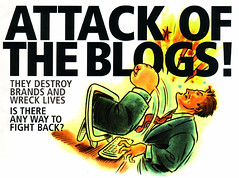
Daniel Lyons, author of the heretofore-anonymous Fake Steve Jobs blog, which comments extensively on companies in the technology industry, was also the author of Forbes' November 2005 cover story "Attack of the Blogs", a 3000-word screed vilifying anonymous bloggers who comment on companies in the technology industry. In 2005, I spoke to Lyons for the article, though the comments I made about both the efforts that have been made to encourage accountability in the blogopshere, as well as the many positive benefits that businesses have accrued from blogging, were omitted from the story.
My initial temptation was to mark Lyons as a hypocrite. Upon reflection, it seems there's a more profound lesson: The benefits of blogging for one's career or business are so profound that they were even able to persuade a dedicated detractor.
First, some background. Attack of the Blogs attracted a good deal of blogosphere attention when it was originally published; It's difficult to overemphasize exactly how strident and one-sided the piece is. Some excerpts to give you a sense of the tone:
Web logs are the prized platform of an online lynch mob spouting liberty but spewing lies, libel and invective. Their potent allies in this pursuit include Google and Yahoo.
...
The online haters have formidable allies amplifying their tirades to a potential worldwide audience of 900 million: Google, Yahoo and Microsoft, plus a raft of other blog hosts. Google is the largest player; its Blogger.com site attracts 15 million visitors a month, more than each of the Web sites of the New York Times, USAToday and the Washington Post. An upstart, Six Apart in SanFrancisco, owns three blogging services--TypePad, LiveJournal and Movable Type--that together run a strong second to Google.
With that mention of my employer, I have to begin the disclaimers. I obviously have a vested interest in preventing people from maligning blogs -- much of my career, and indeed the bulk of the work of my adult life, has been in helping promote opportunities around things like blogs. In addition, I spent a good deal of time on the phone with Lyons for the story, expressing in detail the steps my company had taken to encourage responsible blogging, and instead saw the second paragraph I quoted above, which implies that we somehow benefit from providing services to "online haters".
(To those who'd snipe that I'm only upset I didn't get quoted -- I don't have any interest in getting quoted in lazy, sensationalistic stories. And my points of view were more than adequately voiced by peers I respect, such as Jason Goldman and Frank Shaw.)
The deliberate antagonism of the story was especially frustrating to me because Six Apart, more than any other company involved in blogging, has taken its lumps for its advocacy and efforts around accountability and responsibility. We'd been taken to task years ago by the old-school blogging community for efforts like TypeKey, which provided authentication tools, and were derided by both bloggers and the media for encouraging any accountability for the tone and content of bloggers' words. At the same time, we've been maligned by stories like the Forbes cover for apparently not doing enough to encourage accountability, though I do take some pride (and offer a final disclaimer) in the fact that we host Forbes' blogs on our TypePad service, that Forbes offers the option of using TypeKey to authenticate comments, and that the content of the Forbes blogs is generally excellent.
The useful content of blogs like Forbes' highlights a particularly interesting bit of intellectual dishonesty in the original Attack of the Blogs story. Many of the examples of the most extreme negative behavior come from sources such as Yahoo message boards postings, vituperative emails, even abusive phone calls. Not to put to fine a point on it, but none of these are blogs.
So, should Forbes simply retract the story and issue a correction? Maybe so. Because the most dramatic oversight in the piece was that Forbes neglected its own editorial mission. I am by no means an advocate or supporter of the unalloyed capitalism that seems to be advocated by the magazine's editorial ideology, but I do think it's a position held in good faith, and so I can respect it. But Forbes professes to be an advocate for businesses and entrepreneurs, and by presenting blogs and blogging as a threat, instead of as the single most powerful new tool for improving business communications, the magazine does its target audience a profound disservice.
Which brings us to Fake Steve Jobs. There's no question Dan Lyons does great work under his pseudonym. The blog itself is a must-read, and the canny way the author's true identity has been managed was exceptionally effective at making the blog a breakout success. Since the New York Times outed Lyons, Forbes itself has wasted no time in claiming both the author and the blog as its own.
But the techniques and opportunities created by the success of FSJ illustrate perfectly the flaws in the original Attack of the Blogs story. The immediacy and extremely wide distribution of a blog make it possible to reach a large audience in a very short period of time. The blogosphere's lightning-paced mechanisms for promotion and amplification let the site attract buzz and attention from far outside of its core geek audience. The influence and connections of blog readers got the blog attention from the likes of Bill Gates, and yes, even (the real) Steve Jobs himself less than a year after its launch. And the business value generated was so obvious that Forbes.com compromised on its usually-staid editorial voice in order to include Fake Steve as part of its stable of blogs. And the blog was even hosted by the very same Google that "allied" itself with the "online lynch mobs", and will join those hosted by us who "operate with government-sanctioned impunity".
Blogs are such a good business tool that Forbes has given its most valuable editorial promotion to announce their adoption of one. This, from the magazine whose cover touted that "They Destroy Brands and Wreck Lives".
It makes sense to close with a quote from the story whose creation perhaps inspired Lyons to rethink his view on blogs after he'd completed it.
Google and the like argue they bear no more responsibility for content than a phone company does for slander over its wires. But Google's blog business looks less like a phone company and more like a mix of reality TV and an online magazine. Bloggers provide the fare, and Google maintains it for them free of charge, sometimes selling ads.
Google says ad revenue isn't the point. The real aim is "to let users embrace the Web as a medium of self-expression," a spokesman says. Google lets them run wild.
Dan, aren't you glad you got to run wild?
Some related links:
- The New York Times reveals that Dan Lyons is Fake Steve Jobs. Read to the end as John Markoff (through Brad Stone) not-very-subtly reveals the fact that he has Real Steve Jobs' IM handle on his buddy list.
- Attack of the Blogs, which helped inspire Mena Trott's speech about online accountability.
- An appreciation of an insightful perspective on FSJ by Caroline McCarthy of CNET.
15 Comments
Leave a comment
- Earlier: Web 0.0
- Next: The Enterprise, Apple, and Insufficient Ambition
Surely FSJ was in effect a satire on the type of corporate mouthpiece blog that Lyons was criticising? I don't see how that's hypocritical.
Lyons wrote "Web logs are the prized platform of an online lynch mob spouting liberty but spewing lies, libel and invective."
This is exactly what FSJ's blog was. No alteration in Lyons core beliefs needed.
Are you saying that all blogs are equal? They aren't. Not in content, intent, nor purpose.
IMO, Dan Lyons can only be considered a hypocrite, if one took the FSJ blog as serious commentary on "companies in the technology industry."
Who, in their right minds, would do that? It's like saying you watch Saturday Night Live for indepth analysis of the country's economy.
While the real Steve Jobs must be relieved, the competition in Redmond can be added to the list of the upset. The usually reticent Bill Gates already had some not-so-namaste things to say about the whole Daniel Lyons affair.
Anil you just proved that "lynch mob" thing pretty much by not taking the time to read the "About this blog" section of Dan Lyons blog before posting. See here.
Good, thoughtful article. After reading articles from last evening I was disappointed in what appeared to be just so much messenger-killing and cynicism from the blogger community. The FSJ phenomonon deserved a lot more than that, and I will continue to read it.
You, like others, focused on Lyons' article critical of blogging. However, you've seen that intelligent people can put thigs to good use, and also change their minds. As I said in a post of my own:
"Some look to a Lyons article critical of blogging and claim for him to have written FSJ was hypocrisy. No, it was someone brilliantly turning the medium into a powerful tool. It also shows that smart people can change their minds. Don't be bitter just because he pulled it off while you never even thought of it (and probably couldn't pull it off if you had)."
Fake Steve Jobs is unmasked: The reaction so far is a bit depressing.
Nicely written, Anil. And I agree with your point (clearly missed by flynn) that this is mostly an example of someone who wrote an awful article and now, while never publicly retracting it, has seen the light and is fully encamped with those of us who recognize the amazing power of weblogs. It'll be interesting to see how he handles this moving forward, though -- if Lyons tries to rationalize the two positions as somehow intellectually consistent, then we'll have a different discussion altogether. :)
Jason,
I don't disagree with you, but do believe it depends on how Lyons would choose to "rationalize." I do not believe FSJ was typical of the kind of anonymous blogging he railed against in the article. In that regard, his article and FSJ are not incompatible.
Still, there's no question he re-thought the process and found a way to make it work. Rather than branding him a "hypocrite" (a word all too overused these days), I congratulate him for it.
"Daniel Lyons, author of the heretofore-anonymous Fake Steve Jobs blog, which comments extensively on companies in the technology industry, was also the author of Forbes' November 2005 cover story "Attack of the Blogs", a 3000-word screed vilifying anonymous bloggers who comment on companies in the technology industry."
So? There are many ways to comment on companies in the technology industry. Fake Steve's blog is satire, do you think that Uncle Fester, Beastmaster Bill, the freetards and Squirrel Boy were libelled by Fake Steve?
In the "Attack of the Blogs" story Lyons was specifically referring to attack blogs and stated that "attack blogs are but a sliver of the rapidly expanding blogosphere." It is not easy to admit but I think there is some truth in the article and, to an extent, Mena Trott was making the same point in her speech about civility in blogging and the implications of inflammatory weblog posts. It's an important discussion to have.
Like many others, I fail to see how Daniel Lyons writing 'Attack of the Blogs' and being FSJ makes him a hypocrite...
Do you think he would have been able to use the language and insults that he does in the Secret Diary if he were writing under his own name in Forbes..? It almost proves his point of lack of accountability and ease of making libellous statements. I'm sure that side of it will have to calm down now that it's known who he is and now that Forbes are sponsoring the blog.
This was bound to happen once he went into traditional print media. I just hope he's made plans on how to keep up the good work of FSJ once people know who he is.
From the Attack of the Blogs article: "Blogs started a few years ago as a simple way for people to keep online diaries."
Hee. Sure, that's what they were for. Because that's all the simple, non-journalistic folk really want to do is keep little ole diaries, not comment on the world they live in, or anything. By definition, diaries are kept under lock and key, away from prying eyes.
The fact that Lyons attacked BLOGS themselves, not the anonymity factor of blogs speaks volumes. If he were going after anonymity, his first act would have been to call Movable Type and Google/Blogger and ask them about TypeKey and other identification efforts.
I found that article (and the idea of attacking blogs in general) really suspect, and even more so now that he's been unmasked. Blogs are just a communication medium. They're just a tool. Attacking them seems as ridiculous as getting mad at the telephone because I can use it to call your non-caller-ID-owning grandmother anonymously and tell her what you've been up to. In both cases, your issue is more with the sender of the message rather than the medium they use to send it.
Certainly, the anonymity factor clouds that issue, but only to a small extent. As you pointed out, most blog tool creators are working on that aspect (which Daniel Lyons should be aware of, being a tech commentator and all) and when it comes to real libel issues, most of the time the owner of blog can be tracked down through IP addresses if you're dogged in your pursuit.
I really think Lyon's quibble has more to do with the common man having access to a wide-spread public address system. Blogging tools (and myspace, facebook, youtube) have given the average non-html savvy people a way to have a national audience online, and I think that scares the crap out of two groups of people - the web-building folk, who have had years to feel proprietary about owning the internet, and the so-called "experts" on any subject who already have a national audience and feel entitled to being the center of public attention.
Well, it's a brave new world, folks. You might have to move over an make some room for the great unwashed masses yearning to be free.
Or perhaps I meant "great huddles masses yearning to breathe free." I haven't had coffee yet.
What I find so fascinating and maddening about all of this is the insistence that somehow the loss of Fake Steve's anonymity has "ruined the fun." Why is accountability seen as a negative? I think calling the blog satire is also a misnomer -- it was a tech opinion column, just one presented in a snide and sarcastic tone.
What is a blog? It's an email to the world. It's where you express yourself, share opinions, tell people about your products or can do whatever you want to share. Google loves to rank blogs high and yes, some of the blog content out there can be harmful to corporations. A lot of bloggers make false allegations while others shine a light where light needs to be.
Blogging to me is the second best online invention after email. Just look at the popularity. It helps people connect, find others who share their opinions, it's a great tool and extension of yourself.
Mike Dammann
Nice post. This post is provide very relevant information in this blog.